How Much Should You Save vs Invest – Explained Easy Way

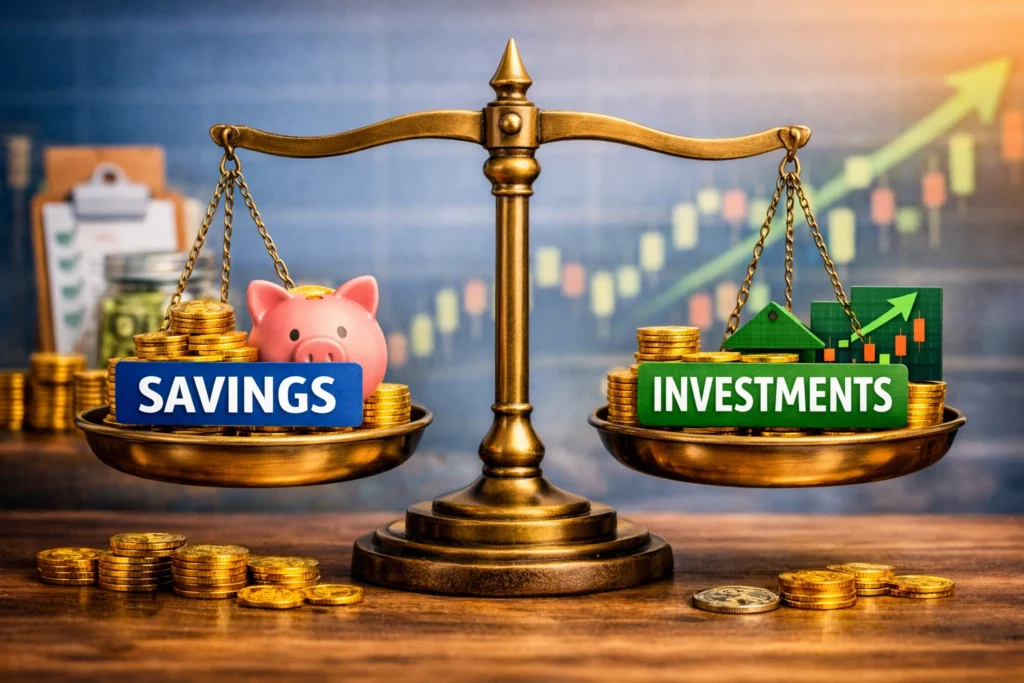
A brass balance scale with “Savings” on one side and “Investments” on the other, surrounded by gold coins, a piggy bank, and a stock chart, symbolizing financial balance and smart money management.

How Much Should You Save vs. Invest?

Deciding how much to save versus invest is one of the most common personal-finance questions, but there is no single percentage that works for everyone.

The right balance depends on your income, essential expenses, emergency-fund needs, debt, financial goals, time horizon, and ability to tolerate investment losses.

For example, someone with unstable income and little emergency savings may need to prioritize building a cash reserve. Someone with stable finances, an adequate emergency fund, and a long-term retirement goal may be able to direct more of their available money toward investments.

Instead of following a fixed rule, a better approach is to determine what your money needs to accomplish first and then allocate it accordingly.

In this guide, we’ll walk through a practical framework for deciding how much to keep in savings, how much to invest, and when other priorities—such as high-interest debt or an employer retirement-plan match—may deserve attention.

How Much Should You Keep in Savings?

Before deciding how much to invest, determine how much cash you need for short-term expenses and emergencies.

Your savings target should be based on your actual financial situation rather than a universal rule. A household with stable income, low fixed expenses, and strong insurance coverage may need a different cash reserve from someone with variable income, higher essential expenses, or greater financial responsibilities.

Start With Your Essential Monthly Expenses

Calculate the expenses you would need to continue paying if your income were temporarily interrupted. These might include:

  • Housing costs
  • Utilities
  • Groceries
  • Transportation
  • Insurance premiums
  • Minimum debt payments
  • Essential healthcare costs
  • Other necessary household expenses

Then consider how many months of these essential expenses you would want your emergency fund to cover.

For example, if your essential expenses are $4,000 per month:

Emergency-Fund TargetApproximate Amount
3 months$12,000
6 months$24,000
9 months$36,000

These figures are examples, not universal recommendations.

Someone with very stable employment may be comfortable with a smaller reserve, while someone with variable income or a household that depends heavily on one income may prefer a larger buffer.

Keep Emergency Savings Accessible

Emergency money should generally be kept somewhere that allows you to access it when needed without exposing it to significant market fluctuations.

Options may include an FDIC-insured savings account or other appropriate deposit account, depending on your needs and account terms.

The purpose of an emergency fund is not to maximize investment returns. Its purpose is to provide financial flexibility when something unexpected happens.

Once you have determined an appropriate emergency reserve, you can focus on how much additional money may be directed toward other priorities, including debt repayment, retirement contributions, and long-term investments.

How Much Can You Afford to Invest?

Once you have an appropriate emergency reserve, the next step is to determine how much of your available cash flow can reasonably go toward long-term investing.

Do not think of investing as simply taking whatever remains in your bank account at the end of the month. Instead, look at your income, essential expenses, debt obligations, short-term goals, and existing savings.

A practical starting point is:

Monthly income − essential expenses − required debt payments − planned short-term savings = amount available for additional financial goals

That amount can then be divided among priorities such as additional emergency savings, debt repayment, retirement contributions, and other investments.

Consider High-Interest Debt

If you have high-interest credit card or other expensive debt, paying it down may deserve priority before making substantial additional taxable investments.

For example, paying down a debt with a high interest rate provides a more predictable financial benefit than investing money and hoping to earn a higher return.

This does not mean everyone should stop investing until all debt is eliminated. Employer retirement-plan matching contributions, the interest rate on the debt, tax considerations, and your overall financial situation can all affect the decision.

Consider Employer Retirement Matching

If your employer offers a retirement plan with matching contributions, understand the matching rules before deciding how to divide your available money.

An employer match can provide an important benefit because the employer is contributing additional money to your retirement account when you meet the plan’s requirements.

After considering the match, emergency savings, debt, and other near-term obligations, you can determine how much additional money may be appropriate for long-term investing.

Focus on a Sustainable Amount

The best investment contribution is not necessarily the largest amount you can invest for one month. It is an amount you can maintain consistently without repeatedly withdrawing investments to cover ordinary expenses.

For example, investing $300 every month for many years may be more sustainable than investing $1,000 for a few months and then stopping because your cash flow becomes too tight.

As your income increases or expenses decrease, you can review your contribution amount and gradually increase it when appropriate.

The objective is to create a sustainable system in which your emergency savings provide short-term protection while your long-term investments have time to compound.

How the 50/30/20 Rule Can Help With Budgeting

The 50/30/20 rule is a popular budgeting framework that divides after-tax income into three broad categories:

  • 50% for needs: Housing, utilities, groceries, transportation, insurance, and other essential expenses
  • 30% for wants: Dining out, entertainment, travel, hobbies, and other discretionary spending
  • 20% for savings and financial goals: Savings, investments, and other financial priorities

However, the 50/30/20 rule should not be treated as a universal formula for deciding how much to save versus invest.

Your actual percentages may look very different depending on your income, housing costs, debt, family responsibilities, location, and financial goals.

For example, someone with a high income and relatively low essential expenses may be able to save and invest considerably more than 20%. Someone dealing with high housing costs or significant debt may temporarily save less while addressing those obligations.

How to Use the Rule More Effectively

If you choose to use the 50/30/20 framework, think of the 20% as a starting point for financial priorities, not as an automatic investment allocation.

You might direct that amount toward:

  1. Building or completing your emergency reserve
  2. Paying down high-interest debt
  3. Contributing to an employer-sponsored retirement plan
  4. Investing for long-term goals
  5. Saving for specific medium-term goals

Once your emergency savings and other priorities are adequately funded, you may be able to direct a larger share of your monthly cash flow toward long-term investments.

The important question is not whether you follow the 50/30/20 rule perfectly. It is whether your spending and saving decisions leave enough cash flow to make consistent progress toward your financial goals.

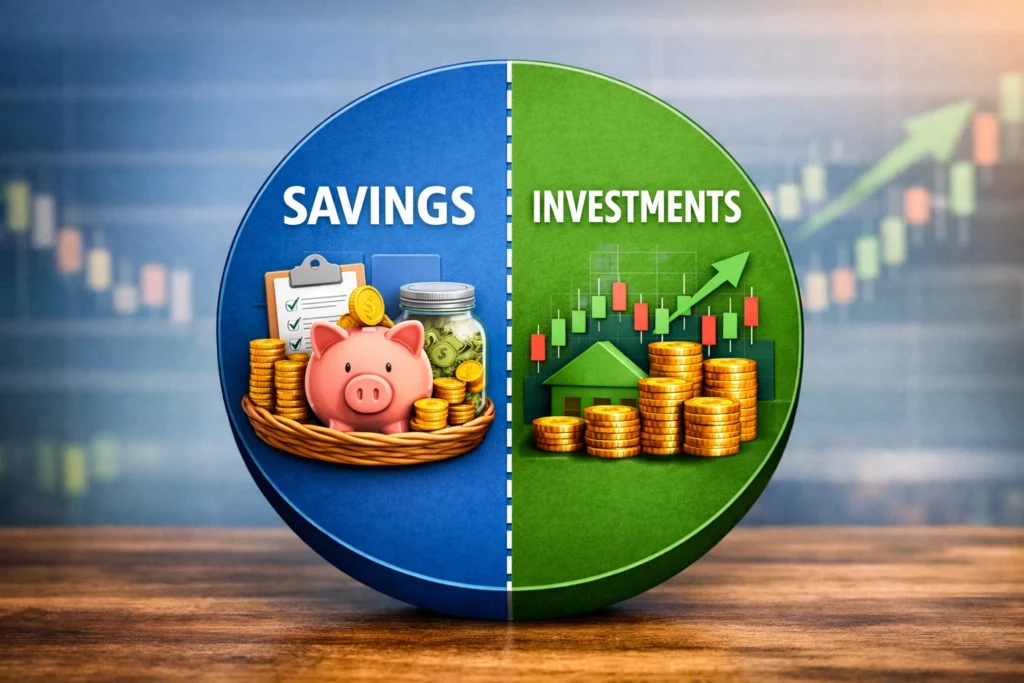
A pie chart divided into two halves, one labeled “Savings” with a piggy bank and coins, and the other labeled “Investments” with a stock chart and house icon, symbolizing financial balance.

A Practical Example: How to Divide $1,000 of Monthly Cash Flow

Suppose you have $1,000 available each month after covering your essential living expenses.

Instead of automatically investing the entire $1,000, first consider your emergency savings, debt, retirement opportunities, and upcoming financial goals.

For illustration, suppose your situation looks like this:

  • Your emergency fund is not yet complete.
  • You have no high-interest credit card debt.
  • Your employer offers a retirement-plan match.
  • You are also working toward long-term wealth building.

A possible allocation could look like this:

Financial PriorityMonthly AmountPurpose
Emergency savings$300Build the cash reserve
Employer retirement plan$300Long-term retirement savings
Additional investments$200Long-term wealth building
Medium-term goal$200Planned future expense
Total$1,000

This is an illustration, not a recommended allocation for everyone.

Once the emergency fund reaches an appropriate level, the $300 previously directed toward emergency savings could potentially be redirected toward another financial priority, such as retirement contributions or long-term investments.

For example, the allocation could then become:

Financial PriorityMonthly AmountPurpose
Emergency savings$0Target already reached
Employer retirement plan$400Long-term retirement savings
Additional investments$400Long-term wealth building
Medium-term goal$200Planned future expense
Total$1,000

The important lesson is that your savings-versus-investing allocation does not have to remain fixed.

As one financial priority is completed, the money can be redirected toward the next priority.

What If You Have High-Interest Debt?

The allocation could look very different if you are carrying expensive debt.

For example, instead of directing $200 toward additional investments, you might temporarily use some or all of that amount toward reducing high-interest debt.

Once the debt is under control, that cash flow can potentially be redirected toward long-term investing.

This creates a flexible system:

Build cash reserves → address expensive debt → capture available retirement benefits → invest for long-term goals → increase contributions as your finances improve.

The exact amounts will depend on your income, expenses, debt costs, financial goals, and risk tolerance.

How Your Savings and Investment Allocation Can Change Over Time

Your savings-to-investment balance does not need to stay the same throughout your life.

Financial priorities often change as your income, expenses, debt, family responsibilities, and goals change.

Early Stage: Building Financial Stability

When you are starting out, a larger portion of your available cash flow may need to go toward building an emergency reserve and addressing expensive debt.

At this stage, investing can still be part of the plan, particularly when an employer retirement-plan match is available, but building financial stability may require greater attention.

Middle Stage: Increasing Long-Term Investments

Once your emergency reserve is established and expensive debt is under control, you may have more flexibility to increase retirement contributions and other long-term investments.

As your income grows, consider increasing your savings and investment contributions rather than automatically increasing spending.

Even small increases in the amount invested each month can make a meaningful difference over a long period because of compounding.

Major Life Changes

Your allocation may also need to change when you experience a major financial event, such as:

  • Buying a home
  • Starting a family
  • Changing jobs
  • Starting a business
  • Taking on significant debt
  • Preparing for a major education expense
  • Approaching retirement

A goal that is many years away may allow for a different approach from a goal that must be funded soon.

As You Approach a Financial Goal

As a major goal gets closer, consider whether the amount of investment risk you are taking remains appropriate.

For example, someone saving for a retirement that is several decades away generally has more time to withstand market fluctuations than someone who expects to use the money within a few years.

This does not mean that everyone should automatically move investments into cash as a goal approaches. The appropriate approach depends on the goal, time horizon, risk tolerance, and overall financial plan.

The key principle is simple:

Your allocation should evolve as your financial circumstances and goals change.

Review your savings, debt, investments, and financial goals periodically rather than assuming that one allocation will remain appropriate forever.

How Much of Your Income Should Go Toward Savings and Investments?

There is no universal savings rate that guarantees financial success. A reasonable target depends on your income, expenses, debt, financial goals, and stage of life.

Instead of focusing on a single percentage, start by calculating how much of your after-tax income is available after essential expenses and required financial obligations.

For example, suppose your monthly after-tax income is $6,000 and your essential expenses and required payments total $4,500.

That leaves:

$6,000 − $4,500 = $1,500

The $1,500 is your available cash flow for additional financial priorities. It does not automatically mean that all $1,500 should be invested.

You might need to divide it among:

  • Emergency savings
  • Retirement contributions
  • High-interest debt repayment
  • Medium-term goals
  • Long-term investments

As your emergency fund becomes adequate and debt is reduced, a greater portion of this available cash flow may be directed toward long-term investing.

Focus on Progress, Not a Perfect Percentage

A common mistake is becoming overly focused on whether you are saving exactly 10%, 20%, or 30% of your income.

A more useful question is:

“Am I consistently increasing the amount of money I am directing toward my financial goals as my financial situation improves?”

For example, someone who currently saves and invests 10% of income may be making excellent progress if they are gradually increasing that percentage as their income rises.

Someone earning considerably more but spending nearly all of the additional income may have less progress despite having a higher salary.

Your savings and investment rate should therefore be viewed as a tool for measuring progress rather than a universal score.

A Simple Progression

You can review your financial priorities in this order:

  1. Cover essential expenses.
  2. Build an appropriate emergency reserve.
  3. Address high-interest debt.
  4. Take advantage of available employer retirement matching.
  5. Fund important medium-term goals.
  6. Increase long-term retirement and investment contributions.
  7. Increase your savings and investment rate when your income rises or expenses fall.

This approach allows your financial plan to become more effective over time without relying on a single percentage that may not fit your circumstances.

What If You Cannot Save or Invest Much Right Now?

Not everyone has enough monthly cash flow to save or invest a large percentage of their income. If your current budget leaves little room for financial goals, the answer is not necessarily to force an unrealistic investment target.

Start by understanding where your money is going.

Review your:

  • Housing costs
  • Transportation expenses
  • Insurance
  • Debt payments
  • Subscriptions
  • Dining and entertainment
  • Other recurring discretionary expenses

Look for expenses that can be reduced without creating an unsustainable budget.

Start With a Manageable Amount

If you can only save or invest $50 or $100 per month, starting there may be more practical than waiting until you can afford a much larger amount.

The important objective is to establish a repeatable habit and increase the amount when your financial situation allows.

For example, you could start with $100 per month and increase the contribution after receiving a pay raise, paying off a loan, or reducing a recurring expense.

Use Windfalls Carefully

Occasional money such as a tax refund, bonus, cash gift, or other unexpected income can also provide an opportunity to strengthen your financial position.

Depending on your circumstances, a windfall could be used to:

  • Build emergency savings
  • Pay down high-interest debt
  • Increase retirement contributions
  • Fund a medium-term goal
  • Increase long-term investments

There is no requirement to invest every extra dollar immediately.

The most important step is to give additional money a deliberate purpose rather than allowing it to disappear through unplanned spending.

Increase Your Rate Gradually

Your financial situation does not have to change dramatically for your savings and investment rate to improve.

A small increase each time your income rises can gradually create a larger contribution without requiring a major lifestyle change.

The goal is progress over time, not perfection from the beginning.

A Step-by-Step Plan for Your Money

Use the following sequence to decide where your available cash flow should go.

Step 1: Calculate Your Monthly Cash Flow

Start with your after-tax income and subtract essential expenses and required debt payments.

This tells you how much money is realistically available for additional financial priorities.

Step 2: Determine Your Emergency-Fund Target

Calculate your essential monthly expenses and determine an emergency reserve appropriate for your income stability, household responsibilities, and financial situation.

Keep this money accessible rather than exposing it to unnecessary market risk.

Step 3: Review High-Interest Debt

Identify credit cards and other high-interest debt.

Consider whether paying down expensive debt should take priority over additional investing, while also considering employer retirement-plan matching opportunities and your broader financial goals.

Step 4: Capture Available Retirement Benefits

If your employer offers a retirement plan with matching contributions, understand the plan’s requirements and consider taking advantage of the available match when appropriate.

Step 5: Fund Medium-Term Goals

Identify goals that you expect to fund within the next several years.

The amount of risk you can reasonably take depends on when you will need the money and whether the goal can tolerate a potential decline in value.

Step 6: Invest for Long-Term Goals

Once your short-term needs and other priorities are addressed, direct appropriate additional cash flow toward long-term investments.

Your investment choices should reflect your time horizon, risk tolerance, diversification needs, fees, and overall financial objectives.

Step 7: Automate Contributions

Automating transfers to savings and investment accounts can make consistent contributions easier and reduce the temptation to spend money that was intended for financial goals.

Step 8: Review and Adjust

Review your income, expenses, emergency savings, debt, investments, and financial goals periodically.

You may need to adjust your allocation when your income changes, debt is paid off, a major expense approaches, or your financial goals change.

The objective is not to follow a perfect percentage. It is to create a system that consistently directs your available money toward the priorities that matter most.

Related Reading

Emergency Savings or Investment Portfolio: What Is Needed First?

Investment vs Savings: How to Grow Your Money Smarter

The Power of Diversification: How to Reduce Risk Smarter

How to Automate Savings and Investments Better

Quick Comparison: Where Should Your Money Go?

Financial PriorityMain PurposeTypical Consideration
Emergency savingsProtect against unexpected expensesKeep accessible and relatively stable
High-interest debtReduce costly interest chargesConsider repayment before additional investing
Employer retirement matchCapture available employer contributionsUnderstand your plan’s matching rules
Medium-term goalsPrepare for planned expensesMatch the approach to the goal’s time horizon
Long-term investingBuild wealth over timeConsider diversified investments appropriate for your risk tolerance
Short-term spending needsCover upcoming expensesPrioritize liquidity and stability

The same dollar does not need to serve every purpose. Separating money by its intended use can make it easier to decide how much should remain in savings and how much can be directed toward investments.

Your priorities may also change over time. Once an emergency-fund target is reached or a debt is paid off, the cash flow previously directed toward that goal can potentially be redirected toward another financial priority.

Conclusion: How Much Should You Save vs. Invest?

There is no single savings-to-investment percentage that works for everyone.

A better approach is to give your money a purpose and prioritize your financial needs based on your circumstances.

Start by calculating your available monthly cash flow. Then consider your emergency-fund needs, high-interest debt, available employer retirement matching, medium-term goals, and long-term investment objectives.

As your financial situation improves, the amount you can direct toward long-term investing may increase.

The key is consistency. You do not need to begin with a large investment contribution. Start with an amount that fits your budget, automate it when practical, and increase your contributions as your income and financial capacity grow.

Think of the process as:

Protect your short-term finances → address expensive debt → take advantage of available retirement benefits → fund important goals → invest for the long term → review and adjust.

Your ideal allocation may change over time, and that’s normal. The goal is not to find a perfect percentage. It is to build a sustainable financial system that helps you make steady progress toward your goals.

Disclaimer: This article is for educational and informational purposes only and does not constitute financial, investment, tax, or legal advice. Examples are for illustration only and do not guarantee future results. Investment returns are not guaranteed and may involve loss of principal. Consider your individual circumstances and consult a qualified professional before making financial decisions.

Leave a Comment

Your email address will not be published. Required fields are marked *