

Saving and investing are often discussed as if they are competing choices, but they serve different financial purposes. Saving generally focuses on keeping money accessible and protecting it from significant loss, while investing involves accepting market risk in pursuit of long-term growth.
The right choice depends on several factors, including when you will need the money, how much risk you can tolerate, how much liquidity you need, and what financial goal you are trying to achieve.
For example, money needed for an emergency next month should generally be treated differently from money being set aside for retirement 20 years from now. Understanding that difference can help you make better decisions about where to keep and grow your money.
In this guide, we’ll compare saving and investing, explain when each approach may make sense, and provide practical examples to help you decide how to allocate your money.
What Are Savings?
Savings are money you set aside for short-term needs, emergencies, planned expenses, or goals where protecting the money and keeping it accessible are more important than maximizing long-term growth.
Common places to keep savings include:
- Savings accounts: Generally provide easy access to your money and may earn interest.
- High-yield savings accounts: Similar to regular savings accounts but may offer more competitive interest rates, depending on the bank and market conditions.
- Certificates of deposit (CDs): Typically pay a fixed interest rate for a specified period, although withdrawing money before maturity may result in a penalty.
- Money market deposit accounts: Bank deposit accounts that may offer interest and relatively easy access, subject to the account’s terms.
Savings are particularly useful for money you may need relatively soon. Examples include an emergency fund, a planned car repair, an upcoming vacation, a home-related expense, or other near-term financial needs.
The main objective of savings is not to generate the highest possible return. It is to keep money available when you need it while earning some interest where possible.
That distinction is important because money needed in the near future generally should not be exposed to the same level of market volatility as money intended for long-term goals.
What Savings Are Good For
Savings can be useful for:
- Emergency expenses
- Short-term financial goals
- Upcoming purchases
- Unexpected bills
- Money that cannot afford to lose value before it is needed
- Maintaining a cash reserve while investing for long-term goals
However, keeping all of your money in cash indefinitely has a potential downside: inflation can reduce its purchasing power over time.
For that reason, saving and investing should not necessarily be viewed as an either-or decision. A financial plan may use savings for short-term stability and investments for longer-term growth.
What Is Investing?
Investing means putting money into assets with the goal of generating income, increasing in value, or both over time. Unlike savings, investing involves accepting some level of risk because the value of many investments can rise or fall.
Common investments include:
- Stocks: Ownership interests in companies that can increase or decrease in value and may pay dividends.
- Bonds: Debt investments that generally pay interest and return principal according to their terms, although they also carry risks.
- Mutual funds: Pooled investment vehicles that hold a collection of securities and are managed according to the fund’s strategy.
- Exchange-traded funds (ETFs): Funds that hold a portfolio of assets and trade on an exchange during market hours.
- Real estate: Property that may generate rental income or appreciate in value, although ownership involves costs, risks, and limited liquidity.
The potential advantage of investing is that your money has an opportunity to grow over a longer period. However, higher potential returns generally come with greater uncertainty. An investment can lose value, sometimes significantly, and past performance does not guarantee future results.
Why People Invest
Investing can help with long-term financial goals such as:
- Retirement
- Building long-term wealth
- Funding future financial goals
- Generating potential investment income
- Maintaining purchasing power over long periods
The appropriate investment depends on factors such as your goal, time horizon, risk tolerance, and ability to withstand temporary or permanent losses.
For example, someone saving money for a purchase they expect to make within a few months may have little capacity to tolerate a major market decline. Someone investing for retirement several decades away may have more time to accept short-term market fluctuations.
Investing Does Not Mean Taking Maximum Risk
A common misconception is that investing means putting money into the riskiest assets available in search of the highest return.
That is not necessarily the case.
Investing can involve different levels of risk. A diversified portfolio may contain a combination of stocks, bonds, and other assets based on an investor’s objectives and risk tolerance.
The key question is not simply, “Which investment can make the most money?”
A better question is:
“Which investment approach is appropriate for this goal, this time horizon, and this level of risk?”
That distinction becomes important when deciding how much money should remain in savings and how much may be appropriate to invest.
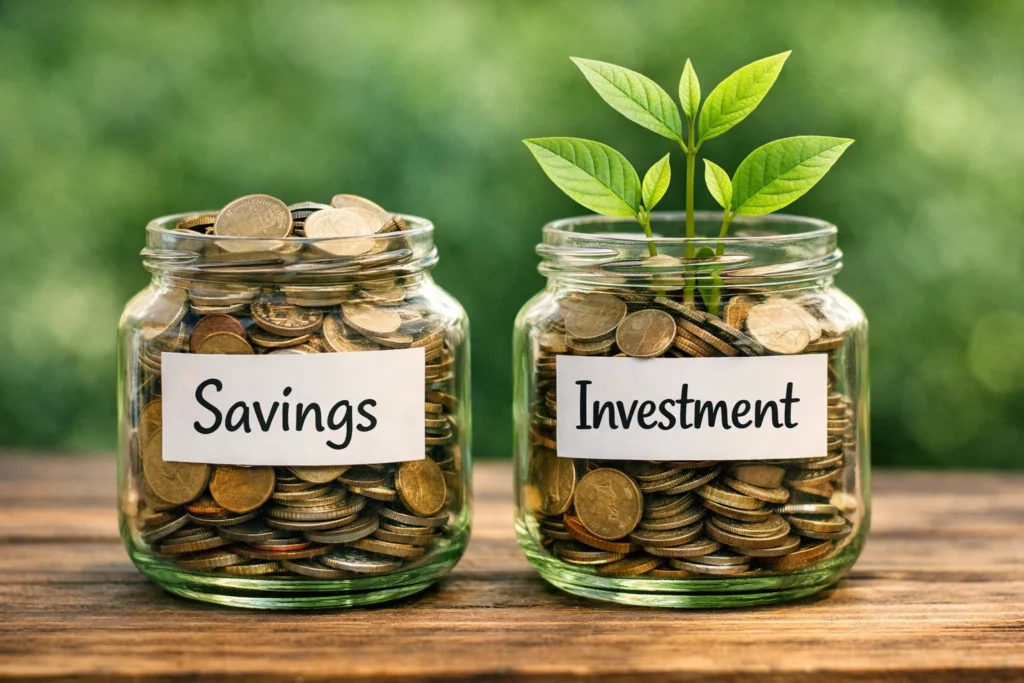
Investment vs Savings: Key Differences
Saving and investing are both important parts of personal finance, but they solve different problems. The biggest difference is the trade-off between accessibility, stability, risk, and long-term growth potential.
| Factor | Savings | Investing |
|---|---|---|
| Primary purpose | Protect and provide access to money for short-term needs | Build wealth and pursue long-term growth |
| Typical time horizon | Short term, often months to a few years | Generally longer term, often several years or more |
| Risk of losing value | Generally lower for insured bank deposits, subject to applicable limits and conditions | Varies by investment and can be substantial |
| Potential return | Generally lower, primarily through interest | Potentially higher, through price appreciation, dividends, interest, or other income |
| Liquidity | Generally high for savings accounts | Depends on the investment; many securities can be sold relatively easily, while some assets may take longer to convert to cash |
| Value fluctuations | Bank account balances generally do not fluctuate with the stock market | Market values can rise and fall, sometimes significantly |
| Inflation risk | Purchasing power can decline if the interest earned is below inflation | Long-term returns may help offset inflation, but this is not guaranteed |
| Common uses | Emergency funds, upcoming expenses, short-term goals | Retirement, long-term wealth building, and other long-term goals |
| Main trade-off | Greater stability and accessibility, but potentially lower long-term growth | Greater growth potential, but with greater uncertainty and risk |
Neither option is automatically better than the other. The appropriate choice depends primarily on when you need the money and how much loss or volatility you can reasonably tolerate.
For example, money needed for an emergency should generally prioritize accessibility and stability. Money that will not be needed for many years may have more capacity to withstand market fluctuations and therefore may be considered for long-term investments.
It is also possible to use both approaches at the same time. Many households maintain a cash reserve for short-term needs while investing a separate portion of their money for long-term goals.
When to Save and When to Invest
The decision to save or invest should start with the purpose of the money, not with a specific percentage or rule.
A practical way to think about the decision is to work through these questions:
1. When will you need the money?
If you expect to need the money soon, keeping it in an appropriate savings vehicle may make more sense because you have less time to recover from a potential investment loss.
If the goal is many years away, investing may provide greater potential for long-term growth, although returns are not guaranteed.
2. Do you have an emergency reserve?
An emergency fund can help cover unexpected expenses without forcing you to sell investments during an unfavorable market period.
There is no single emergency-fund amount that works for everyone. Consider factors such as your essential monthly expenses, income stability, dependents, insurance coverage, and access to other resources when determining an appropriate cash reserve.
3. Do you have expensive debt?
High-interest debt can significantly affect your finances. Before investing additional money, consider whether paying down expensive debt should be a priority.
For example, if a credit card is charging a high interest rate, reducing that balance can provide a more predictable financial benefit than taking additional investment risk.

4. Are you receiving an employer retirement-plan match?
If your employer offers a retirement-plan contribution match, understand the plan’s matching rules before deciding where to direct additional savings. An employer match can be an important part of a retirement-saving strategy.
5. What is your time horizon?
Your time horizon is one of the most important factors in deciding between saving and investing.
| Time Horizon | General Consideration |
|---|---|
| Less than 1 year | Prioritize accessibility and stability for money you expect to need soon |
| 1–5 years | Consider the goal, required stability, and your ability to tolerate losses |
| 5+ years | You may have greater capacity to consider investments for long-term growth |
| Retirement decades away | Long-term investing may play an important role, depending on your overall financial plan |
These are general guidelines rather than strict rules. A five-year goal, for example, may require a different approach depending on whether the money must be available on a specific date or whether the goal can be delayed.
A Simple Decision Framework
Before moving money from savings into investments, ask:
What is this money for? → When will I need it? → Can I tolerate a decline in value? → Do I have enough emergency reserves? → Do I have expensive debt to address? → Does my retirement plan offer an employer match?
This framework helps prevent a common mistake: investing money that should have remained available for a near-term financial need.
At the same time, keeping all long-term savings in cash may expose the money to inflation risk and reduce its potential for long-term growth.
The objective is not to choose savings or investments once and never change. Your allocation can evolve as your income, goals, expenses, risk tolerance, and time horizon change.
A Simple Example: Saving vs. Investing $10,000
Consider someone who has $10,000 available for a long-term financial goal.
Suppose, purely for illustration, that the money earns 3% annually in a savings account or 7% annually in an investment portfolio, with returns compounded annually. These rates are hypothetical and do not represent guaranteed or expected returns.
After 10 years:
| Approach | Hypothetical Annual Return | Approximate Value After 10 Years |
|---|---|---|
| Savings | 3% | $13,439 |
| Investing | 7% | $19,672 |
The difference comes from compounding and the higher assumed rate of return. Under these assumptions, the investment example ends with approximately $6,233 more after 10 years.
However, this example does not mean that investments will always earn 7% or that savings will always earn 3%. Actual savings rates can change, and investment returns vary from year to year. An investment could also lose value during some periods.
For example, an investment portfolio might experience a significant decline shortly after the money is invested. Someone who needs the $10,000 during that downturn could face a very different outcome from someone who can leave the money invested for many years.
The example therefore illustrates an important principle:
The longer your time horizon, the more opportunity you may have to benefit from compounding and accept short-term market fluctuations. The shorter your time horizon, the more important liquidity and stability may become.
What If You Add Money Regularly?
The difference can become more significant when you contribute consistently over many years.
For example, suppose someone invests $500 per month for 20 years and earns a hypothetical 7% annual return, compounded monthly. They would contribute $120,000 of their own money, while the hypothetical account value would be approximately $260,000.
That additional growth would come from the hypothetical investment returns and compounding, not from additional contributions.
Again, this is an illustration rather than a forecast. Actual investment results depend on the assets selected, fees, taxes, market conditions, contribution timing, and other factors.
How Inflation Affects Savings and Investments
Inflation is another reason the difference between saving and investing matters.
Inflation means that prices generally increase over time, reducing the amount of goods and services that a dollar can buy. If your money earns less than the rate of inflation over a long period, its purchasing power can decline even though the dollar balance in your account increases.
For example, suppose you keep $10,000 in an account that earns 2% per year while inflation averages 3% per year over the same period. Your account balance would still increase in dollar terms, but your purchasing power would not keep pace with rising prices.
Investments can provide greater long-term growth potential and may help investors keep pace with or exceed inflation over long periods. However, this is not guaranteed. Investment values can decline, and some investments may perform poorly for extended periods.
This creates an important trade-off:
- Savings can provide stability and accessibility, which can be valuable for short-term needs.
- Investments can provide greater long-term growth potential, but they involve market risk.
- Inflation can affect both, particularly when the return on your money does not keep pace with rising prices.
The goal is therefore not simply to find the option with the highest return. It is to match the purpose of the money with an appropriate combination of stability, liquidity, risk, and growth potential.
For short-term goals, protecting access to the money may matter more than maximizing returns. For long-term goals, accepting some investment risk may provide a greater opportunity to preserve and increase purchasing power over time.
What Happens When Investments Lose Value?
Investing does not produce a smooth upward line. The value of investments can rise and fall as markets, companies, interest rates, economic conditions, and investor expectations change.
Understanding these risks is an important part of investing, and our guide to investing safely explores practical ways to manage investment risk.
For example, suppose you invest $10,000 and the portfolio falls by 20%. Its value would temporarily decline to approximately $8,000.
A decline like this does not automatically mean the investment has permanently lost $2,000. If the underlying investments recover and you do not sell during the decline, the portfolio could regain value over time. However, recovery is never guaranteed, and some investments can experience permanent losses.
This is why your time horizon matters.
Someone who needs $10,000 next month may not have enough time to wait through a major market decline. Someone investing money for a retirement goal several decades away may have considerably more time to tolerate market fluctuations.
Why Selling During a Market Decline Can Matter
Selling an investment after it has fallen converts an unrealized decline into a realized loss and removes the possibility of participating in a future recovery of that investment.
However, simply holding an investment is not always the correct decision either. An investment may have deteriorating fundamentals, excessive risk, or no longer fit your financial objectives.
The important lesson is not to avoid every decline. It is to understand the risk before investing and make sure the money is appropriate for the investment’s time horizon.
A useful question to ask before investing is:
“If this investment temporarily loses 20% or 30% of its value, would I still be able to meet my financial obligations and stay invested according to my plan?”
If the answer is no, the money may need to be treated differently from money intended for a long-term investment goal.
How to Find the Right Balance Between Savings and Investments
There is no universal percentage that everyone should keep in savings or investments. The appropriate balance depends on your financial situation and the purpose of the money.
Instead of starting with a rule such as “save 20% and invest 80%,” start by assigning your money to specific goals.
Step 1: Cover Your Near-Term Needs
Identify expenses you expect to pay in the near future. This could include upcoming bills, planned purchases, insurance premiums, education expenses, or other known obligations.
Money needed soon generally deserves a higher priority on accessibility and stability.
Step 2: Build an Appropriate Emergency Reserve
Determine how much cash you may need if an unexpected expense or interruption in income occurs.
Your target should reflect your essential expenses and personal circumstances rather than following an arbitrary number. Someone with highly stable income and someone with irregular income may reasonably need different cash reserves.
Step 3: Address Expensive Debt
Review high-interest debt before directing large amounts of additional money toward investments.
Paying down expensive debt can reduce future interest costs and improve monthly cash flow. The appropriate priority depends on the interest rate, debt terms, available cash, and other financial goals.
Step 4: Take Advantage of Available Retirement Benefits
If you have access to an employer-sponsored retirement plan, understand the contribution rules and any employer matching contribution before deciding where additional savings should go.
An employer match can be an important part of a long-term retirement strategy.
Step 5: Invest Money Intended for Long-Term Goals
Once your short-term needs, emergency reserves, and other important priorities are addressed, money intended for long-term goals may have a greater capacity to be invested.
The investment approach should match your time horizon and risk tolerance. A diversified portfolio may be appropriate for some investors, but diversification does not eliminate the possibility of loss.
A Simple Way to Organize Your Money
Instead of thinking of your finances as “savings versus investments,” think of them as different buckets:
Bucket 1 — Money you need soon
Keep an appropriate amount accessible and focused on stability.
Bucket 2 — Emergency reserves
Maintain cash that can help cover unexpected expenses or income disruptions.
Bucket 3 — Medium-term goals
Choose savings or investments based on when the money will be needed and how much loss you can tolerate.
Bucket 4 — Long-term wealth building
Consider investments appropriate for your goals, time horizon, and risk tolerance.
This approach allows savings and investments to work together rather than treating them as competing choices.
When Your Balance Should Change
Your savings and investment allocation does not have to remain fixed.
You may need more cash when:
- Your income becomes less predictable
- You expect a large upcoming expense
- You take on significant new debt
- Your financial responsibilities increase
- You are approaching a major financial goal
You may be able to direct more money toward long-term investments when:
- Your emergency reserve is adequate
- High-interest debt is under control
- Your short-term goals are funded
- Your income and expenses provide sufficient cash flow
- Your long-term goals can tolerate market fluctuations
The goal is not to find a perfect savings-to-investment ratio. The goal is to give each dollar a job that matches when you need it, how much risk you can accept, and what you are trying to accomplish.
Related Reading
- How Much Should You Save vs. Invest? Explained the Easy Way — Learn how to think about allocating money between savings and investments.
- Emergency Savings or Investment Portfolio: What Is Needed First? — Understand how emergency savings and investing can fit together.
- Investing for Beginners: Step-by-Step Guide to Start Building Wealth — Learn the basics of getting started with investing.
- How to Invest Safely: 10 Smart Strategies — Explore practical ways to manage investment risk.
Common Savings and Investing Mistakes to Avoid
Understanding the difference between saving and investing is only part of the process. How you use each one also matters.
1. Investing Money You May Need Soon
Putting short-term money into volatile investments can create a problem if the market falls just when you need the money.
Before investing, consider whether you can leave the money invested long enough to withstand potential market fluctuations.
2. Keeping All Long-Term Money in Cash
The opposite mistake is keeping money intended for long-term goals entirely in cash without considering inflation and the potential benefits of long-term investing.
Cash can provide stability, but its purchasing power may decline over time if the return does not keep pace with inflation.
3. Chasing the Highest Possible Return
A higher potential return usually comes with greater risk. Choosing an investment solely because it has produced strong returns in the past can lead to taking more risk than your financial situation can support.
Consider the investment’s risk, diversification, fees, time horizon, and role in your overall financial plan.
4. Investing Without an Emergency Reserve
An unexpected expense can force you to sell investments at an unfavorable time if you do not have sufficient accessible cash.
An appropriate emergency reserve can provide flexibility and reduce the need to depend on investments for unexpected expenses.
5. Ignoring High-Interest Debt
Investing while carrying expensive debt can make it harder to improve your overall financial position.
Compare the cost of the debt with your other financial priorities and consider whether reducing high-interest balances should come first.
6. Treating a Savings Rate or Investment Return as Guaranteed
Savings account rates can change, and investment returns can vary substantially from year to year.
Avoid building a financial plan around a single assumed return without considering uncertainty and potential downside.
7. Confusing Diversification With Guaranteed Safety
Owning several investments does not eliminate risk. Diversification can help reduce the impact of a poor result from one investment or asset, but a diversified portfolio can still lose value.
8. Focusing Only on Account Balances
A growing account balance does not automatically mean you are making progress toward your goals.
Review whether your savings and investments are actually aligned with what the money is intended to accomplish.
A useful habit is to review your financial goals, cash reserves, debt, investment allocation, and time horizons periodically rather than making decisions based only on short-term market movements.
A Simple Savings vs. Investing Decision Checklist
If you are unsure whether a particular amount of money belongs in savings or investments, work through this checklist:
Question 1: What is the money for?
Identify the specific purpose before deciding where to keep the money.
Is it for:
- An emergency?
- A purchase in the near future?
- A medium-term goal?
- Retirement?
- Long-term wealth building?
The purpose determines what level of accessibility and risk may be appropriate.
Question 2: When will you need the money?
Estimate when you expect to use it.
The shorter the time until the money is needed, the less opportunity you generally have to recover from a market decline. Longer time horizons may provide more capacity to tolerate market volatility.
Question 3: What happens if the money temporarily loses value?
Imagine the money declining substantially.
Would you still be able to pay your bills and meet your goal?
If a significant decline would create a financial problem, consider whether the money should be kept in a more stable and accessible form.
Question 4: Do you have an emergency reserve?
Consider whether you have enough accessible money to handle unexpected expenses without depending on your investment portfolio.
Your appropriate emergency reserve depends on your expenses, income stability, household responsibilities, insurance, and other resources.
Question 5: Do you have high-interest debt?
Review credit cards and other expensive debt before investing additional money.
Reducing high-interest debt may be an important financial priority because interest costs can significantly reduce your ability to build wealth.
Question 6: Are your investments appropriate for your risk tolerance?
If you decide to invest, make sure the level of risk is consistent with your ability and willingness to withstand losses.
Do not choose an investment simply because it has produced high returns in the past.
Question 7: Are you reviewing the plan periodically?
Your financial situation can change.
A new job, income change, major purchase, family responsibility, debt, or approaching financial goal may change how much money you need in savings versus investments.
The Bottom Line
A simple rule of thumb is:
Money you need soon → prioritize accessibility and stability.
Money for long-term goals → consider investments appropriate for your time horizon and risk tolerance.
Money needed for emergencies → maintain an appropriate cash reserve.
Expensive debt → evaluate whether paying it down should take priority.
This is not a formula that determines the correct answer for everyone. It is a framework for thinking about the purpose of your money before deciding where to put it.
Frequently Asked Questions
Is saving better than investing?
Neither is automatically better. Savings are generally more appropriate for emergencies, short-term needs, and money that must remain accessible. Investing may be more appropriate for long-term goals where you can tolerate market fluctuations in pursuit of potential growth.
How much money should I keep in savings?
There is no single amount that applies to everyone. Consider your essential expenses, income stability, dependents, insurance coverage, debt obligations, and access to other resources when determining an appropriate emergency reserve.
Should I save before I start investing?
It depends on your circumstances. Building an appropriate emergency reserve and addressing high-interest debt can be important priorities before increasing long-term investments. However, retirement contributions and employer matching opportunities may also deserve consideration.
Can I save and invest at the same time?
Yes. Saving and investing can serve different purposes within the same financial plan. For example, you might maintain an emergency reserve in accessible savings while investing money intended for retirement or other long-term goals.
Is investing riskier than saving?
Generally, investments such as stocks and stock-based funds have greater potential for price fluctuations and loss than insured bank deposits, but risk varies significantly among different investments. Savings held at an FDIC-insured bank are generally protected against bank failure up to applicable coverage limits, while investment accounts are not protected against market losses by FDIC insurance.
How long should I keep money in savings instead of investing?
The answer depends on when you expect to need the money and how much loss you can tolerate. Money needed in the near term generally benefits from greater stability and accessibility. Money intended for long-term goals may have a greater capacity to withstand market fluctuations.
Can investing guarantee higher returns than a savings account?
No. Investing can provide greater long-term growth potential, but returns are not guaranteed. Investment values can decline, and actual results depend on the assets, market conditions, fees, taxes, and investment period.
What is the biggest difference between saving and investing?
The fundamental difference is the objective and trade-off. Saving generally prioritizes accessibility and stability, while investing generally accepts greater risk and uncertainty in exchange for the potential for long-term growth.
Conclusion: Saving and Investing Work Together
Saving and investing are not competing financial strategies. They are tools designed for different purposes.
Savings can provide accessibility and stability for emergencies, short-term goals, and expenses that need to be funded soon. Investing can provide greater long-term growth potential for money that you may not need for many years, while also exposing you to market risk.
The key is to match the money to the goal.
Before deciding where to put your money, consider:
- What is the money for?
- When will you need it?
- How much liquidity do you need?
- Can you tolerate a temporary or permanent loss?
- Do you have an appropriate emergency reserve?
- Do you have high-interest debt that needs attention?
- Are your investments appropriate for your time horizon and risk tolerance?
There is no single savings-to-investment ratio that works for every household. Your financial priorities can also change over time.
The goal is not to choose between saving and investing once and forget about the decision. Instead, build a financial system in which short-term money is accessible, emergency reserves provide a safety net, and long-term money has an opportunity to grow in a way that matches your risk tolerance and financial goals.
When each dollar has a purpose, saving and investing can work together to support both your financial stability today and your long-term financial goals.
Continue Your Financial Planning
If you want a structured way to organize your financial goals, spending, saving, debt, and wealth-building priorities, you can also explore the Financial Freedom Blueprint: Build Wealth, Clear Debt, and Live Free — One Step at a Time on Amazon Kindle.
It provides practical guidance for building better money habits and creating a long-term financial plan.
Disclaimer: This article is for educational and informational purposes only and does not constitute financial, investment, tax, or legal advice. Examples and calculations are hypothetical and do not guarantee future results. Investment returns are not guaranteed and may involve loss of principal. Financial rules and circumstances vary, so verify current information with appropriate sources and consider consulting a qualified professional before making financial decisions.