
Introduction
When I first started investing in the U.S. market, I was torn between index funds and ETFs. Both promised diversification, low fees, and long‑term growth — but choosing between them felt like picking between two great coffee blends. Over the years, I’ve learned that understanding their subtle differences can make a huge impact on your financial journey.
If you’ve ever wondered which is better for your portfolio — index funds or ETFs — this guide will break it down with real‑life examples, practical insights, and tools to help you make smarter investment decisions.
My Real‑Life Turning Point
A client named Mark, a 32‑year‑old engineer from Seattle, invested $500 monthly in an S&P 500 index fund. His friend Lisa chose an ETF tracking the same index. After five years, both had similar returns — but Lisa’s ETF gave her more flexibility to trade during market hours, while Mark’s fund offered automatic reinvestment and simplicity.
That’s when I realized: the best choice depends on your investing style, not just returns.
(Interlink: How to Create a Balanced Portfolio – Explained Better)
What Are Index Funds and ETFs?
🧩 Index Funds
An index fund is a mutual fund that tracks a specific market index — like the S&P 500 or Nasdaq 100. You buy shares directly from the fund company at the end of the trading day.
Key features:
- Passive management (low fees)
- Automatic reinvestment of dividends
- Ideal for long‑term investors
💹 ETFs (Exchange‑Traded Funds)
An ETF also tracks an index but trades like a stock on an exchange. You can buy or sell it anytime during market hours.
Key features:
- Real‑time trading flexibility
- Lower expense ratios
- Tax efficiency
(Interlink: The FIRE Movement Explained: How to Retire Early & Live Free)
Step 1: Compare Costs and Fees
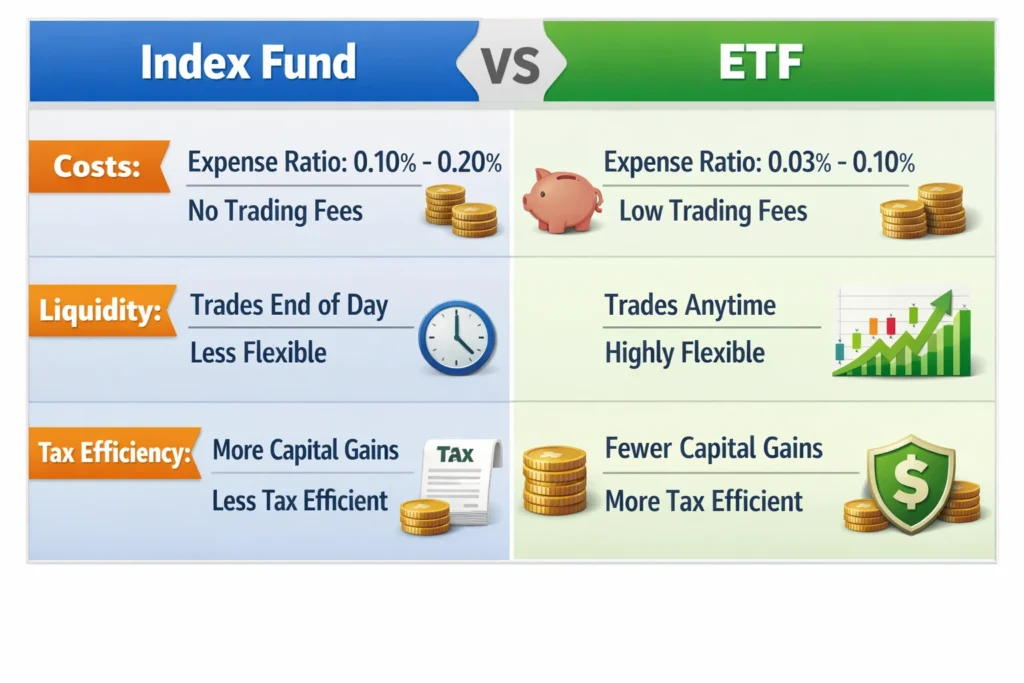
Both index funds and ETFs are known for low costs, but ETFs often have a slight edge.
| Feature | Index Fund | ETF |
|---|---|---|
| Expense Ratio | 0.10–0.20% | 0.03–0.10% |
| Trading Fees | None (if direct purchase) | Brokerage fees may apply |
| Minimum Investment | Often $500–$3,000 | As low as one share |
If you’re starting small, ETFs may be more accessible. But if you prefer automatic investing, index funds simplify the process.
(Interlink: Savings Today or Wealth Tomorrow? Choosing the Right Path)
Step 2: Liquidity and Flexibility
ETFs allow you to trade throughout the day — perfect for active investors. Index funds, however, execute trades only once daily after market close.
Example: If the market dips at noon, ETF investors can buy immediately. Index fund investors must wait until the day’s end.
So, if you value flexibility, ETFs win. If you prefer a “set‑and‑forget” approach, index funds are ideal.
Step 3: Tax Efficiency
ETFs are generally more tax‑efficient because of their unique structure. They use an “in‑kind” creation and redemption process that minimizes capital gains distributions.
Index funds, on the other hand, may trigger taxable events when fund managers adjust holdings.
(Interlink: The Role of Inflation in Savings – The Shocking Truth You Need to Know)
Step 4: Dividend Reinvestment
Index funds automatically reinvest dividends — a huge advantage for compounding. ETFs require manual reinvestment unless your broker offers an automatic plan.
If you’re focused on long‑term wealth building, index funds make reinvestment effortless.
Step 5: Accessibility and Automation
If you prefer automation, index funds integrate seamlessly with tools like:
- 📊 Monthly Budget Planner → Track your investment contributions.
- 🛠️ Complete Financial Toolkit → Manage your portfolio and rebalance easily.
- 📘 Financial Freedom Blueprint Ebook → Learn how to automate your path to financial independence.
These tools help you stay consistent — the secret ingredient to long‑term success.
(Interlink: Financial Literacy: Skills to Master Your Money Better)
Step 6: Real‑World Example
A couple from Austin invested $1,000 monthly — one in an index fund, the other in an ETF. After 10 years, both achieved similar returns (~9% annually). But the ETF investor saved slightly more in taxes and had better liquidity during market dips.
The takeaway? Both are excellent — but your lifestyle determines which fits best.
Step 7: Frequently Asked Questions
Q1: Which is better for beginners — index funds or ETFs? Index funds are simpler for beginners due to automatic reinvestment and no trading complexity.
Q2: Can I lose money in ETFs or index funds? Yes, both carry market risk. Diversification reduces risk but doesn’t eliminate it.
Q3: Are ETFs riskier than index funds? Not necessarily — they track the same indexes. The difference lies in trading flexibility.
Q4: How do your tools help investors? The Complete Financial Toolkit and Financial Freedom Blueprint Ebook guide you to automate investments, track returns, and stay consistent.
(Interlink: Emergency Savings or Investment Portfolio — What Comes First?)
Step 8: Common Mistakes to Avoid
- Chasing short‑term performance
- Ignoring expense ratios
- Overtrading ETFs
- Not reinvesting dividends
Avoid these pitfalls to maximize your returns and minimize stress.
Step 9: Emotional Side of Investing
Investing isn’t just numbers — it’s psychology. Many investors panic during market dips, selling at the worst time. But those who stay consistent — whether in index funds or ETFs — reap long‑term rewards.
Remember: discipline beats timing.
Step 10: The Verdict — Which Is the Best Option?
If you prefer simplicity and automation, index funds are your best friend. If you value flexibility and tax efficiency, ETFs are the smarter choice.
Ultimately, both are powerful tools for building wealth. Start with one, stay consistent, and let compounding work its magic.
Use the 📘 Financial Freedom Blueprint Ebook and 🛠️ Complete Financial Toolkit to design your personalized investment roadmap today.
Disclaimer
This article is for educational purposes only and does not constitute financial advice. Always consult with a licensed financial advisor before making investment or budgeting decisions.