

Introduction
When December approaches, many salaried employees in the U.S. start thinking about holidays, bonuses, and vacation plans — but few realize it’s also the perfect time for year‑end tax planning.
Smart tax planning isn’t about scrambling at the last minute; it’s about reviewing your finances and making small, strategic moves that help you save more and reduce your tax burden before the year closes.
Many salaried employees wait until tax season to think about their taxes. By then, some planning opportunities may already have passed. A year-end review can help you check your withholding, retirement contributions, health accounts, investments, deductions, and other factors that may affect your tax situation before the year ends.
A Hypothetical Example: Laura’s Year-End Tax Review
Consider a hypothetical example. Laura is a 36-year-old HR manager in Chicago who wants to become more proactive about her taxes. During a year-end review, she discovers that she hasn’t fully reviewed her retirement contributions, health benefits, withholding, or charitable giving. By reviewing these areas before the tax year ends, she can identify which opportunities may apply to her situation and make informed decisions for the following year.
Related: [Tax Planning for Salaried Employees – How To Save More]
Step 1: Review Your Retirement Contributions
Year-end is a good time to review how much you’re contributing to your employer-sponsored retirement plan and whether your current contributions fit your financial goals.
Traditional 401(k)
Contributions to a traditional 401(k) are generally made with pre-tax dollars and can reduce your taxable income for the year, subject to applicable rules and limits. The money can generally grow tax-deferred, while withdrawals are generally taxable as ordinary income.
Roth 401(k)
If your employer offers a Roth 401(k), contributions are made with after-tax dollars and generally don’t reduce your taxable income today. Qualified distributions can generally be tax-free when the applicable requirements are met.
Traditional and Roth IRA
A Traditional IRA and Roth IRA have different tax treatments. A Traditional IRA may provide a tax deduction for eligible contributions, while Roth IRA contributions are made with after-tax money and qualified withdrawals can generally be tax-free.
You may be able to have both types of IRA, but annual contribution limits generally apply across your combined Traditional and Roth IRA contributions. Eligibility and deductibility can also depend on factors such as income, filing status, and access to a workplace retirement plan.
Check Before the Year Ends
Review:
- Your year-to-date retirement contributions
- Your employer’s matching contribution
- Whether your employer offers a Roth 401(k)
- Your current tax situation
- Your expected income for the year
- Whether increasing contributions fits your budget and goals
If your employer offers a matching contribution, understand the plan’s rules and consider contributing enough to receive the available match if appropriate for your situation.
Related:[Tax Saving Investments: Explained for Beginners]
Step 2: Review Your HSA and FSA Before Year-End
Health and flexible spending accounts can provide valuable tax advantages, but their rules are different. Year-end is a good time to check your balance, eligible expenses, contribution elections, and your employer’s plan rules.
Health Savings Account (HSA)
If you’re eligible for an HSA, contributions may provide tax benefits, investment earnings can generally grow tax-free, and withdrawals used for qualified medical expenses can generally be tax-free.
Unlike an FSA, unused HSA funds generally remain available from year to year.
Before the end of the year, check:
- Your current HSA balance
- Whether you have eligible medical expenses you need to pay
- Your planned contribution for the next year
- Whether your employer contributes to your HSA
- Whether your investment options and account fees are appropriate
Flexible Spending Account (FSA)
An FSA can allow eligible employees to set aside pre-tax money for qualified expenses.
However, don’t assume that all unused FSA money disappears on December 31. Depending on your employer’s plan, there may be a limited carryover or grace period.
Check your specific plan documents to determine:
- Your remaining balance
- Eligible expenses
- Any applicable carryover amount
- Whether your plan provides a grace period
- The deadline for submitting eligible expenses
Review Your Benefits for Next Year
Open enrollment and year-end planning can also be a good opportunity to review your expected healthcare and dependent-care expenses and make appropriate benefit elections for the following year.
Related: [Emergency Funds Explained: How to Build Your Ultimate Financial Safety Net]
Step 3: Review Potential Deductions and Tax Credits
Before the tax year ends, review the deductions and tax credits that may apply to your circumstances. The important point is not to claim every possible expense, but to understand which tax breaks you actually qualify for under current rules.
Depending on your situation, areas worth reviewing may include:
- Standard vs. itemized deduction: Determine which approach is appropriate for your circumstances.
- Charitable contributions: Qualifying donations may provide a deduction when the applicable requirements are met.
- Mortgage interest: Eligible homeowners who itemize may be able to deduct qualifying mortgage interest, subject to applicable rules and limits.
- Student loan interest: Eligible taxpayers may be able to deduct qualifying student loan interest, subject to income and other requirements.
- Tax credits: Review whether you qualify for credits related to dependents, education, energy improvements, or other eligible expenses.
Keep Your Records
Gather relevant documents before tax-filing season, such as:
- Donation receipts
- Mortgage-interest statements
- Student-loan records
- Education-related documents
- Tax forms
- Other records supporting deductions or credits you may claim
Don’t Assume an Expense Is Deductible
A common mistake is assuming that an expense becomes deductible simply because it is related to your job or finances.
Federal tax rules can be specific, and some deductions have eligibility requirements, income limits, or other restrictions. Verify the current IRS rules before claiming a deduction or credit.
Related: [Stop Losing Money: 7 Tax Planning Mistakes You Must Avoid]
Step 4: Review Your Federal Tax Withholding
Your employer generally withholds federal income tax from each paycheck and sends it to the IRS on your behalf.
At year-end, review whether your withholding is reasonably aligned with your expected tax liability.
If You Owe a Large Amount
A significant tax bill when you file may indicate that not enough tax was withheld during the year, although the reason can vary.
This can happen after:
- Starting a second job
- Receiving substantial bonus or other income
- Getting married
- Having changes in dependents
- Starting freelance or self-employment work
- Experiencing significant changes in income or deductions
If You Receive a Large Refund
A large refund isn’t necessarily bad, but it generally means more of your money was withheld during the year than was ultimately needed to cover your tax liability.
Some people deliberately prefer a larger refund as a form of forced saving. Others prefer to keep more money in each paycheck throughout the year.
The objective is to understand your withholding and choose an approach that fits your financial circumstances.
Review Your W-4
If your circumstances have changed, review your Form W-4 and consider whether your withholding needs to be updated.
The IRS Tax Withholding Estimator can help you assess your federal withholding.
If your tax situation is complicated, consider consulting a qualified tax professional.
Step 5: Plan for Bonuses and Other Year-End Income
Year-end bonuses, commissions, stock compensation, freelance income, and other additional income can affect your overall tax situation.
Receiving a larger bonus does not mean your entire income is taxed at a higher rate. The U.S. federal income tax system uses progressive tax brackets, so different portions of taxable income can be taxed at different rates.
Review Your Bonus Withholding
Employers may use specific federal withholding rules when paying supplemental wages such as bonuses. The amount withheld from the bonus paycheck is not necessarily the same as your final tax liability for the year.
If you receive a significant bonus, consider reviewing your total year-to-date income and withholding rather than assuming the withholding amount represents your final tax bill.
Consider How the Extra Income Fits Your Plan
Before spending a large bonus, consider whether it could help with:
- Building or replenishing an emergency fund
- Paying down high-interest debt
- Increasing eligible retirement contributions
- Funding other financial goals
- Increasing savings for upcoming expenses
If you are considering additional contributions to an IRA, HSA, or retirement plan, check your eligibility, contribution limits, and applicable deadlines first.
Don’t Make an Investment Just for the Tax Benefit
A tax advantage should not be the only reason to make an investment.
Consider the investment’s risk, fees, liquidity, time horizon and role in your overall financial plan before committing your bonus.
Related:[ The Debt Payoff Blueprint: A Step‑by‑Step Plan That Works]
Step 6: Review Investment Gains and Losses
If you have investments in a taxable brokerage account, review your realized and unrealized gains and losses before the end of the year.
Selling an investment for a profit can create a capital gain, while selling an investment for less than its cost basis can create a capital loss.
Consider Tax-Loss Harvesting Carefully
Tax-loss harvesting involves realizing eligible investment losses that may be used to offset capital gains, subject to IRS rules.
Depending on your circumstances, excess capital losses may also be available to offset a limited amount of ordinary income, with additional losses potentially carried forward under the applicable rules.
However, don’t sell an investment simply because it has declined in value.
Before realizing a loss, consider:
- Whether you actually have gains to offset
- Your investment’s role in your portfolio
- Your investment time horizon
- Transaction costs
- The tax consequences
- The wash-sale rules, which can restrict the tax benefit when substantially identical securities are purchased around the sale
Review Your Portfolio Before Year-End
A year-end investment review can help you identify:
- Realized gains and losses
- Unrealized gains and losses
- Dividend and interest income
- Taxable investment distributions
- Opportunities to rebalance
- Whether your current investments still fit your goals
Tax considerations should be part of the decision—not the only reason to buy or sell an investment.
Related: [How Tax-Efficient Investing Helps Build Wealth Faster]
Step 7: Organize Your Tax Documents
Don’t wait until tax-filing season to start gathering your records. Create a simple tax folder—digital or physical—and keep relevant documents together as they become available.
Documents to Watch For
Depending on your circumstances, these may include:
- W-2: Wage and salary information from your employer
- 1099 forms: Investment, interest, freelance, retirement, or other income
- Mortgage-interest statement: If you own a qualifying home loan
- Student-loan interest statement: If applicable
- Retirement-account records
- HSA or FSA records
- Charitable donation receipts
- Records supporting eligible deductions or credits
- Investment transaction records
- Records of estimated tax payments, if applicable
Some tax documents may not arrive until after the calendar year ends, so this is about organizing your records early, not completing your tax return in December.
Keep Your Records Secure
Tax documents contain sensitive financial information. Store them securely and avoid sending unprotected copies through unsecured channels.
Keeping organized records can make tax preparation easier and help you respond if the IRS or your tax professional needs supporting documentation.
Step 8: Review Insurance and Employer Benefits
Year-end or your employer’s open-enrollment period can be a good time to review benefits that affect both your finances and your tax situation.
Check Your Beneficiaries
Review the beneficiaries listed on:
- 401(k) and other retirement accounts
- Life insurance policies
- Other accounts where beneficiary designations apply
Make sure the information still reflects your wishes.
Review Your Health Coverage
Compare your current health plan with the options available for the coming year.
Consider:
- Premiums
- Deductibles
- Out-of-pocket maximums
- Employer contributions
- HSA eligibility
- Expected healthcare expenses
A plan with a lower premium isn’t necessarily the cheapest option overall if you expect significant healthcare costs.
Review Other Employer Benefits
Depending on your employer, review benefits such as:
- Life insurance
- Disability insurance
- Dependent-care benefits
- Flexible spending accounts
- Health savings accounts
- Retirement-plan options
Don’t automatically choose the same benefits every year. Consider your expected needs for the coming year.
Step 9: Build Your Tax Plan for Next Year
A year-end review should not stop with the current tax year. Use what you’ve learned to prepare for the year ahead.
Before the new year begins, consider:
- Expected income: Will your salary, bonus, investment income, or side income change?
- Retirement contributions: Should you adjust your contribution rate?
- HSA or FSA: What contribution and benefit elections make sense for your expected expenses?
- Withholding: Does your current W-4 still reflect your circumstances?
- Investment strategy: Could your taxable investments generate significant gains, losses, dividends, or interest?
- Major life changes: Are you expecting a marriage, new child, home purchase, job change, or other significant financial event?
- Financial goals: How much do you want to save, invest, or use toward debt during the coming year?
Turn the Review Into a Simple Annual Routine
You don’t need to spend weeks doing tax planning.
A short review at the end of each year can help you identify questions to research, documents to gather, and decisions to make before the new tax year gets underway.
If your financial or tax situation is complex, consider discussing your circumstances with a qualified tax professional.
Frequently Asked Questions
Q1. What is the most important year-end tax-planning step for a salaried employee?
Start by reviewing your income, federal tax withholding, retirement contributions, employer benefits, and any major changes in your personal circumstances. The right priorities depend on your individual situation.
Q2. Can I contribute to both a Traditional IRA and a Roth IRA?
You may be able to have both types of IRA, but the annual IRA contribution limit generally applies across your combined contributions to Traditional and Roth IRAs. Eligibility and deductibility can also depend on income, filing status, and access to a workplace retirement plan.
Q3. Should I increase my 401(k) contribution before the end of the year?
If you have room under the applicable contribution limit and increasing your contribution fits your financial situation, additional contributions to a traditional 401(k) may reduce taxable income for the year. However, the tax treatment depends on whether you use a traditional or Roth contribution and on the applicable rules.
If your employer provides matching contributions, understand the plan’s matching rules before making changes.
Q4. Should I use my FSA balance before December 31?
Not necessarily. FSA rules vary by employer plan. Some plans may allow a limited carryover or grace period, so check your specific plan’s rules and deadlines before the end of the year.
Q5. Is an HSA better than an FSA?
Neither is automatically better for everyone. They have different eligibility requirements, contribution rules, and features. An HSA can allow unused funds to remain available from year to year, while an FSA can be useful for employees with predictable eligible expenses.
Q6. Can tax-loss harvesting reduce my taxes?
Tax-loss harvesting may allow eligible investment losses to offset capital gains, subject to applicable IRS rules. However, selling an investment at a loss isn’t automatically beneficial, and investors need to consider the wash-sale rules and the investment consequences before making a transaction.
Q7. When should I start planning for next year’s taxes?
You can begin reviewing your next year’s tax situation as part of your year-end checklist. Changes in salary, bonuses, benefits, retirement contributions, investments, family circumstances, or side income may all warrant a review.
The Bottom Line: Prepare Before the Tax Year Ends
Year-end tax planning isn’t about rushing to find last-minute deductions. It’s about reviewing your finances while there is still time to make appropriate decisions for the current tax year and prepare for the next one.
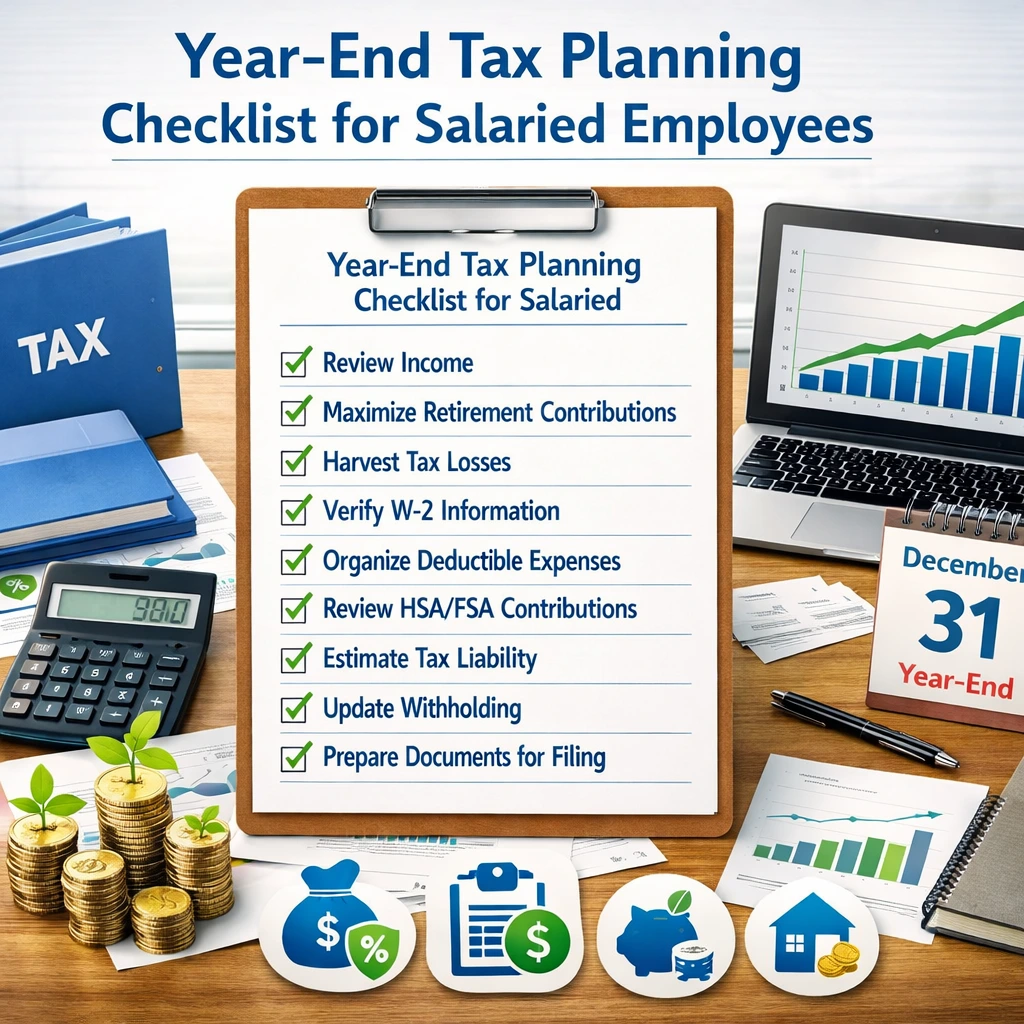
Use this checklist to review:
- Retirement contributions
- HSA and FSA balances and elections
- Tax withholding
- Potential deductions and credits
- Bonuses and other income
- Investment gains and losses
- Tax documents
- Insurance and employer benefits
- Your plan for the coming year
Not every strategy will apply to every taxpayer. Your eligibility for deductions, credits, retirement accounts, and other tax benefits depends on your individual circumstances and current tax rules.
For complex tax situations, verify the latest information with the IRS or consult a qualified tax professional.
The goal isn’t to eliminate taxes. It’s to make informed decisions before the year ends.
Disclaimer
This article is for educational purposes only and does not constitute financial advice. Always consult with a certified tax professional before making investment decisions.