
Introduction
Paying off debt is easier when you have a clear plan. Without one, it is easy to make monthly payments without knowing which debt to prioritize, how much extra you can realistically pay, or how to prevent new debt from replacing the old.
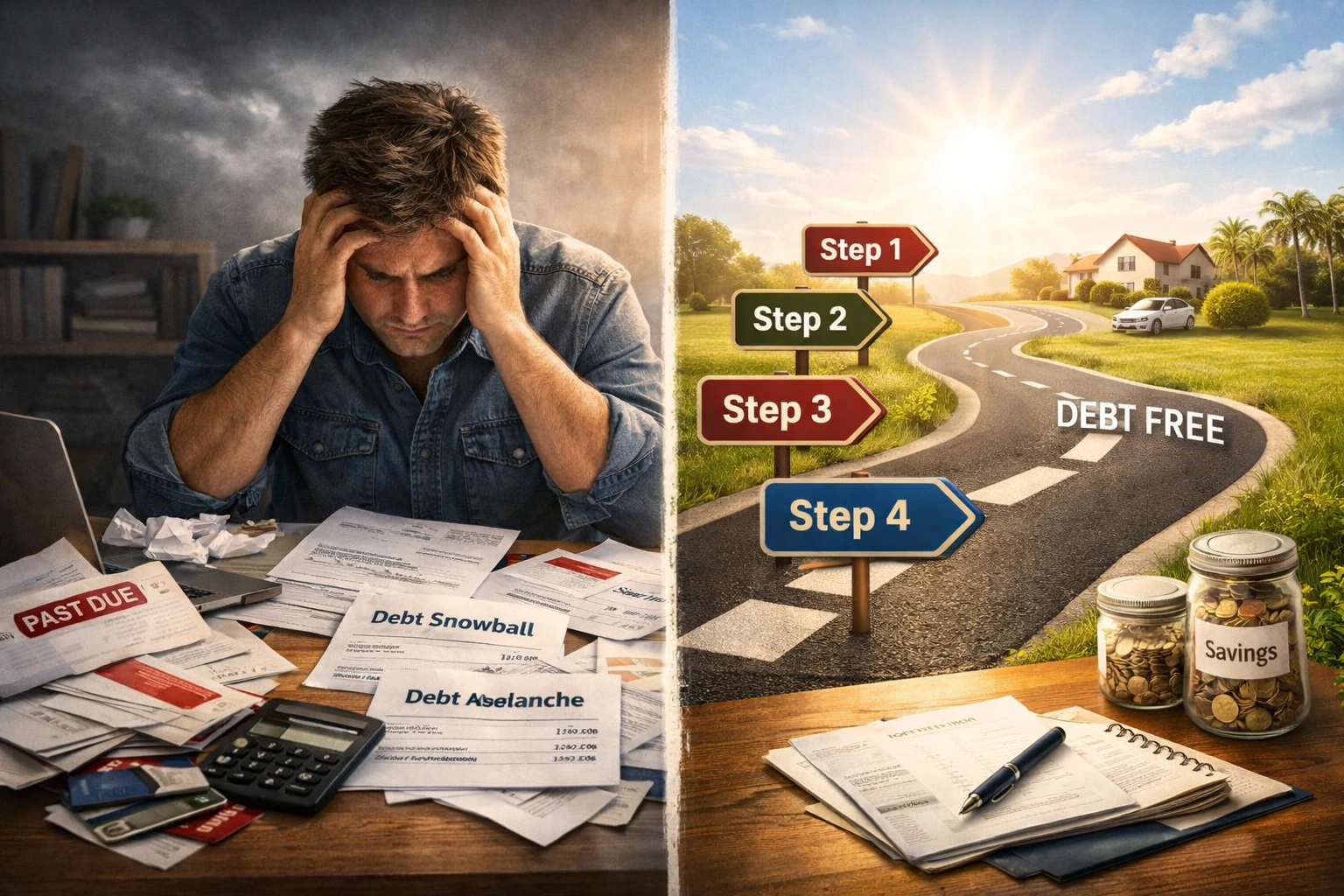
A practical debt payoff plan starts with understanding what you owe, protecting your essential expenses, choosing a repayment strategy, and consistently directing extra money toward your target debt.
The goal is not necessarily to eliminate every nonessential expense or put every available dollar toward debt. A sustainable plan should help you reduce debt while still leaving enough room for essential costs, unexpected expenses, and a reasonable quality of life.
This guide walks through a step-by-step debt payoff blueprint covering debt organization, repayment strategies, budgeting, automation, emergency savings, income growth, consolidation decisions, and progress tracking.
The right approach will depend on your debt balances, interest rates, income, expenses, and financial priorities. The important thing is to create a strategy you can follow consistently and adjust as your circumstances change.
Step 1: List Every Debt and Minimum Payment
Before choosing a payoff strategy, create a complete picture of what you owe. List each debt separately rather than looking only at the total balance.
For each debt, record:
- Current balance
- Interest rate (APR)
- Minimum monthly payment
- Due date
- Type of debt, such as credit card, personal loan, auto loan, or student loan
This information makes it easier to see which debts are costing you the most and how much of your monthly income is already committed to required payments.
Pay particular attention to high-interest debt, especially revolving credit-card balances. Interest can make these balances much more expensive to carry over time.
At this stage, don’t worry about making extra payments yet. First make sure your list is complete and that you are making at least the required minimum payments on every debt.
Once you know your balances, interest rates, and minimum payments, you can choose a repayment method that fits your priorities.
For a closer look at how credit-card minimum payments can keep debt around longer and increase interest costs, see The Credit Card Trap: How Minimum Payments Drain Your Wealth.

Step 2: Protect Your Financial Foundation
Before putting every available dollar toward debt, make sure your basic financial foundation is stable. A debt-payoff plan can fail if an unexpected expense forces you to rely on new credit again.
Start by making at least the minimum required payment on every debt and keeping essential household expenses current.
Then build a small emergency buffer appropriate to your circumstances. The right amount depends on factors such as your income stability, essential expenses, insurance coverage, and family responsibilities. Even a modest cash reserve can provide some protection against unexpected expenses while you work on high-interest debt.
At the same time, avoid adding new high-interest debt whenever possible. If you continue charging expenses to credit cards while making payments on existing balances, your progress can become much harder to measure and sustain.
Your financial foundation should therefore cover three priorities:
- Keep all required debt payments current.
- Maintain a reasonable cash buffer for unexpected expenses.
- Prevent new high-interest debt from replacing the debt you are trying to eliminate.
Once these basics are in place, you can direct additional money toward your chosen debt-payoff strategy.
Step 3: Choose Your Debt-Payoff Strategy
Once you know your balances, interest rates, and minimum payments, choose a repayment method you can follow consistently.
Two common approaches are:
| Method | How it works | Main advantage |
|---|---|---|
| Debt Snowball | Pay minimums on all debts and direct extra money toward the smallest balance first. | Provides quicker psychological wins. |
| Debt Avalanche | Pay minimums on all debts and direct extra money toward the debt with the highest interest rate first. | Generally minimizes interest when all other factors are equal. |
With either method, you continue making the required minimum payments on your other debts. When the target debt is paid off, redirect the money that had been going toward it to the next debt.
The Avalanche method can be mathematically efficient because it prioritizes the debt costing you the most in interest. The Snowball method can be easier to stick with because eliminating smaller balances can create visible progress and motivation.
Neither method is automatically right for everyone. The best choice is the one that fits your financial situation and that you can follow consistently.
For a detailed comparison of the two approaches, including when each may make sense, see Debt Payoff Showdown: Snowball vs Avalanche — Which Saves You More?.
Step 4: Build a Realistic Debt-Payoff Budget
Once you have chosen your repayment method, determine how much you can realistically put toward debt each month.
Start with your take-home income and subtract essential expenses such as housing, utilities, food, transportation, insurance, and other necessary costs. Then account for your required minimum debt payments.
The amount remaining is not automatically your debt-payoff amount. Leave room for irregular expenses, a reasonable emergency contribution, and some discretionary spending so that your plan remains sustainable.
A simple framework is:
Take-home income − essential expenses − minimum debt payments − planned savings = amount available for extra debt payments
Look for recurring expenses that can be reduced without making your budget unrealistic. Subscriptions you rarely use, unnecessary fees, frequent impulse purchases, or other low-value spending can create additional room for debt payments.
You can also set a specific monthly extra-payment target. For example, if your budget consistently allows an additional $400 after covering your essential obligations and planned savings, you could direct that amount toward your current target debt.
The goal is not to create the most aggressive budget possible. It is to create a budget you can repeat month after month without relying on credit whenever an ordinary unexpected expense occurs.
Step 5: Automate Your Debt Payments
Once your repayment plan is set, make it as easy as possible to follow consistently.
Set up automatic payments for at least the minimum required amount on each debt. This can help reduce the risk of missed payments and late fees.
Then make your additional debt payment according to the strategy you selected:
- With the Debt Snowball, direct extra money toward your smallest remaining balance.
- With the Debt Avalanche, direct extra money toward your highest-interest remaining debt.
When one debt is completely paid off, redirect the money you were paying toward it to the next target rather than allowing that amount to disappear into additional spending.
It’s also useful to review your automatic payments periodically. Check that payment amounts, bank-account details, due dates, and balances are still correct, particularly after a loan is refinanced, a credit-card balance changes, or a debt is paid off.
Automation should support your plan—not replace it. Continue reviewing your debts and budget so you can increase payments when your financial situation improves.
Step 6: Increase Your Debt-Payoff Capacity
Cutting expenses can create room in your budget, but there is a limit to how much you can reduce spending. Increasing the amount of money available for debt payments can also accelerate your progress.
Look for opportunities to improve your cash flow without creating an unsustainable lifestyle.
You could:
- Ask for additional responsibilities, pursue a promotion, or develop skills that can increase your earning potential.
- Consider freelance work, consulting, tutoring, or other side income that fits your schedule.
- Direct part of a bonus, tax refund, or other unexpected income toward your debt.
- Reduce recurring expenses that provide little value.
- Review your budget whenever your income changes and increase your debt payment when you can comfortably afford to do so.
If you earn additional income, decide in advance how much will go toward debt rather than allowing all of it to become additional spending.
For example, you might decide that 50% of an unexpected bonus goes toward debt while the remainder is allocated to savings or other financial priorities. The exact split should reflect your circumstances.
The objective is not to work more indefinitely or eliminate every enjoyable expense. It is to find sustainable ways to increase the amount you can consistently direct toward debt.
If you want additional strategies for accelerating repayment without completely sacrificing your lifestyle, see How to Become Debt-Free Faster Without Sacrificing Your Lifestyle.
Step 7: Protect Your Progress With an Emergency Fund
Debt payoff can become difficult if an unexpected expense forces you to borrow again. An emergency fund can provide a buffer for expenses such as urgent repairs, medical bills, or a temporary loss of income.
The right emergency-fund target depends on your circumstances. Consider your essential monthly expenses, income stability, insurance coverage, dependents, and access to other resources when deciding how much cash to keep available.
If you have very limited savings and high-interest debt, you may choose to build a smaller initial cash buffer while directing more of your available money toward expensive debt. As your debt burden falls and your financial position improves, you can gradually increase your emergency savings.
Keep emergency savings somewhere that is safe, accessible, and separate from money intended for long-term investing.
The purpose is not to build the largest possible cash balance while carrying expensive debt. It is to create enough financial resilience that an unexpected expense does not immediately force you to add new high-cost debt.
Once your debt is under control, you can continue strengthening your emergency fund toward a level that better matches your long-term needs.
For a more detailed guide to building an emergency reserve, see Emergency Fund Explained: How to Build Your Strong Financial Safety Net.
Step 8: Consider Debt Consolidation Carefully
Debt consolidation can simplify multiple debts by combining them into a single loan or payment, but it is not automatically a way to save money.
Before consolidating, compare:
- Annual percentage rate (APR) of the new debt with the rates on your existing debts
- Origination, transfer, or other fees
- Repayment period
- Total interest and total amount you will repay
- Monthly payment
- Whether the new debt is secured or unsecured
- Whether the new payment fits comfortably within your budget
A lower monthly payment can sometimes result from extending the repayment period, which may increase the total interest you pay even if the new rate is lower.
Also consider why the original debt accumulated. If consolidation lowers your payments but you continue adding new credit-card balances, you could end up with both the consolidated debt and new debt.
Consolidation may be worth considering when it genuinely improves the cost or manageability of your debt and you have a realistic plan to avoid rebuilding the balances.
For debt involving personal loans, see Personal Loans: When to Use or Avoid Them.
Step 9: Track Your Progress and Adjust Your Plan
Debt payoff is easier to manage when you can see whether your plan is actually working.
At least once a month, review:
- Current balance on each debt
- Interest charged
- Minimum payments
- Extra payments made
- Total debt remaining
- Progress toward your target payoff date
Don’t judge your progress only by how quickly one balance falls. Your overall debt balance and the amount of interest you are paying are more useful measures of whether your strategy is working.
When you completely pay off one debt, redirect the money that was going toward it to your next target. This allows your available debt-payment amount to grow without requiring a completely new budget each time.
You should also adjust your plan when your circumstances change. A salary increase, job change, major expense, new debt, or change in household responsibilities can affect how much you can realistically pay each month.
Tracking progress can also provide motivation. Instead of focusing only on the amount you still owe, recognize measurable improvements such as reducing your total balance, eliminating a high-interest account, or lowering the amount of interest you pay.
The objective is consistent progress, not perfection.
Step 10: Avoid Going Back Into Debt
Paying off debt is only part of the goal. You also want to create habits that make it less likely that the same balances will return.
Watch for these common problems:
- Continuing to rely on credit for everyday expenses when your budget cannot cover them.
- Paying only minimums indefinitely on high-interest revolving debt.
- Increasing spending as soon as a debt is paid off instead of redirecting the freed-up payment toward savings or other financial goals.
- Using debt to cover recurring budget shortfalls rather than addressing the underlying spending or income problem.
- Draining your emergency savings for nonessential purchases, leaving you vulnerable to the next unexpected expense.
- Taking on new loans without considering the total repayment cost, even when the monthly payment appears affordable.
You do not need to avoid credit completely to maintain healthy finances. The important distinction is whether borrowing is being used deliberately and whether you can comfortably manage the resulting payments.
As your debt decreases, consider redirecting the money that previously went toward debt toward emergency savings, retirement contributions, or other long-term financial goals.
The ultimate goal is not simply to reach a zero balance. It is to build a financial system that makes staying out of expensive debt easier.
Step 11: Manage the Emotional Side of Debt
Debt can affect more than your bank account. Persistent financial obligations may create stress, guilt, frustration, or tension within a household, especially when progress seems slow.
Recognizing the emotional side of debt can make it easier to build a plan you can actually maintain.
A few practices can help:
- Focus on measurable progress. Track your total debt balance rather than judging yourself by how much remains.
- Avoid all-or-nothing thinking. One unexpected expense or difficult month does not mean your entire plan has failed.
- Set realistic milestones. Breaking a large debt target into smaller goals can make the process feel more manageable.
- Discuss the plan with your household. If you share finances with a partner or family members, agreeing on priorities can reduce conflict and make the plan easier to follow.
- Leave room for reasonable spending. A plan that eliminates every enjoyable expense may be difficult to sustain over several years.
Debt payoff is a financial process, not a measure of your personal worth. The objective is to make steady progress while building habits that improve your financial stability over time.
Hypothetical Example: How a Debt-Payoff Plan Can Work
Consider a hypothetical household with the following debts:
| Debt | Balance | APR | Minimum Payment |
|---|---|---|---|
| Credit card A | $8,000 | 24% | $200 |
| Credit card B | $3,000 | 18% | $90 |
| Personal loan | $10,000 | 10% | $250 |
Their total debt is $21,000, and their required minimum payments total $540 per month.
After covering essential expenses and maintaining an appropriate emergency buffer, suppose their budget allows them to put an additional $300 per month toward debt.
They could choose either:
- Debt Avalanche: direct the extra $300 toward Credit Card A because it has the highest APR.
- Debt Snowball: direct the extra $300 toward Credit Card B because it has the smallest balance.
With either approach, they would continue making the required minimum payments on the other debts. Once the first target is paid off, they would redirect that freed-up payment toward the next debt.
This example illustrates why the repayment method should be chosen deliberately. The Avalanche approach can reduce interest costs when the debts and payments are otherwise comparable, while the Snowball approach can provide faster visible wins that may help some people stay consistent.
The actual payoff time and total interest would depend on the payment amounts, interest calculations, fees, and whether additional charges are added to the accounts.
The key lesson: a successful debt-payoff plan combines a clear inventory of debts, a realistic monthly payment, a consistent strategy, and the discipline to avoid rebuilding the balances.
Common Debt-Payoff Mistakes to Avoid
A debt-payoff plan can fail even when the basic strategy is sound. These are some of the most common mistakes to watch for:
1. Paying Extra Toward Debt While Missing Other Minimum Payments
Always keep the required minimum payments current on your other debts before directing additional money toward your target debt. Missing payments can lead to fees, credit damage, and other consequences.
2. Focusing Only on the Monthly Payment
A lower monthly payment does not necessarily mean a loan is cheaper. When evaluating refinancing or consolidation, consider the APR, fees, repayment period, and total amount you will repay.
3. Ignoring High-Interest Debt
High-interest revolving balances can grow expensive over time. Make sure you understand which debts are costing you the most before deciding where to direct extra payments.
4. Using New Debt to Fund Everyday Spending
If you continue relying on credit cards to cover regular expenses while paying down existing balances, your overall debt may not decrease as expected.
5. Draining All Available Cash to Pay Debt
Putting every dollar into debt can leave you vulnerable to an unexpected expense. Maintain an emergency buffer appropriate to your circumstances so that one financial setback does not immediately create new debt.
6. Creating an Unrealistic Budget
A debt plan that leaves no room for normal discretionary spending can become difficult to maintain. A sustainable plan is generally more useful than an extremely aggressive plan that you abandon after a few months.
7. Treating the First Plan as Permanent
Your income, expenses, interest rates, and household circumstances can change. Review your debt-payoff plan periodically and adjust it when necessary.
The strongest debt-payoff strategy is not necessarily the most aggressive one. It is the one that reduces expensive debt consistently while keeping your overall financial situation stable.
Frequently Asked Questions About Debt Payoff
Which debt should I pay off first?
After making the required minimum payments on all debts, you can use either the Debt Avalanche method, which prioritizes the highest interest rate, or the Debt Snowball method, which prioritizes the smallest balance.
The better choice depends on whether minimizing interest or maintaining motivation is the more important factor for you.
Should I consolidate my debt?
Debt consolidation may make sense in some situations, but a lower monthly payment alone does not mean you will save money. Compare the new APR, fees, repayment period, and total repayment cost with your existing debts before making a decision.
How much should I put toward debt each month?
There is no universal amount. Start with your income and essential expenses, make all required minimum payments, maintain an appropriate emergency buffer, and then determine how much additional money your budget can sustainably direct toward debt.
Should I stop saving while paying off debt?
Not necessarily. Maintaining some emergency savings can reduce the risk of taking on new debt when unexpected expenses occur. The appropriate balance between saving and debt repayment depends on your interest rates, financial stability, and circumstances.
How can I stay motivated while paying off debt?
Track your total debt balance and celebrate meaningful milestones. Breaking a large goal into smaller targets can make the process easier to manage. It can also help to review your progress regularly rather than focusing only on the amount you still owe.
What should I do after paying off my debt?
Redirect at least part of the money that was previously going toward debt toward your next financial priorities. These might include building a stronger emergency fund, contributing to retirement accounts, investing, or saving for other important goals.
Bottom Line: Build a Debt-Payoff Plan You Can Sustain
Becoming debt-free does not require a perfect budget or an extreme lifestyle. It requires a clear understanding of what you owe, a realistic repayment strategy, and consistent follow-through.
A strong debt-payoff plan should help you:
- Know your balances, interest rates, and minimum payments.
- Keep required payments current.
- Choose between the Snowball and Avalanche methods based on your priorities.
- Create enough room in your budget for additional debt payments.
- Maintain an appropriate emergency buffer.
- Increase your debt-payoff capacity when your income or circumstances allow.
- Avoid taking on new high-cost debt.
- Review and adjust the plan as your financial situation changes.
The objective is not simply to reach a zero balance as quickly as possible. It is to reduce debt while building financial stability that lasts after the debt is gone.
Once expensive debt is under control, the money that previously went toward debt can be redirected toward emergency savings, retirement, investing, or other long-term financial goals.
A sustainable plan beats an extreme plan you cannot maintain.
Disclaimer
This article is for educational purposes only and does not constitute financial advice. Always consult with a certified financial advisor before making major financial decisions.