

Introduction
When December approaches, many salaried employees in the U.S. start thinking about holidays, bonuses, and vacation plans — but few realize it’s also the perfect time for year‑end tax planning.
Smart tax planning isn’t about scrambling at the last minute; it’s about reviewing your finances and making small, strategic moves that help you save more and reduce your tax burden before the year closes.
While I helping professionals with their finances, I noticed that most people wait until April to think about taxes — when it’s too late to make meaningful changes. This checklist will help you take control now, so you can start the new year with confidence and extra savings in your pocket.
Laura’s Year End Tax Planning Checklist
A client named Laura, a 36‑year‑old HR manager from Chicago, once told me, “I always end up paying more taxes than I expect.” When we reviewed her finances in December, we found she hadn’t optimized her 401(k), missed deductions for charitable donations, and hadn’t used her FSA balance.
After following a simple year‑end tax planning checklist, Laura saved $2,900 in taxes and redirected those savings into her emergency fund.
(Interlink: Tax Planning for Salaried Employees – How To Save More)
Step 1: Maximize Retirement Contributions
Retirement accounts are the easiest way to save taxes while securing your future.
401(k):
- Contributions are tax‑deductible.
- Employers often match your contributions — free money!
- You pay taxes only when you withdraw in retirement.
Roth IRA:
- Contributions are made with after‑tax money.
- Withdrawals in retirement are completely tax‑free.
Example: Laura increased her 401(k) contributions by $2,000 before year‑end and reduced her taxable income immediately.
(Interlink: Tax Saving Investments: Explained for Beginners)
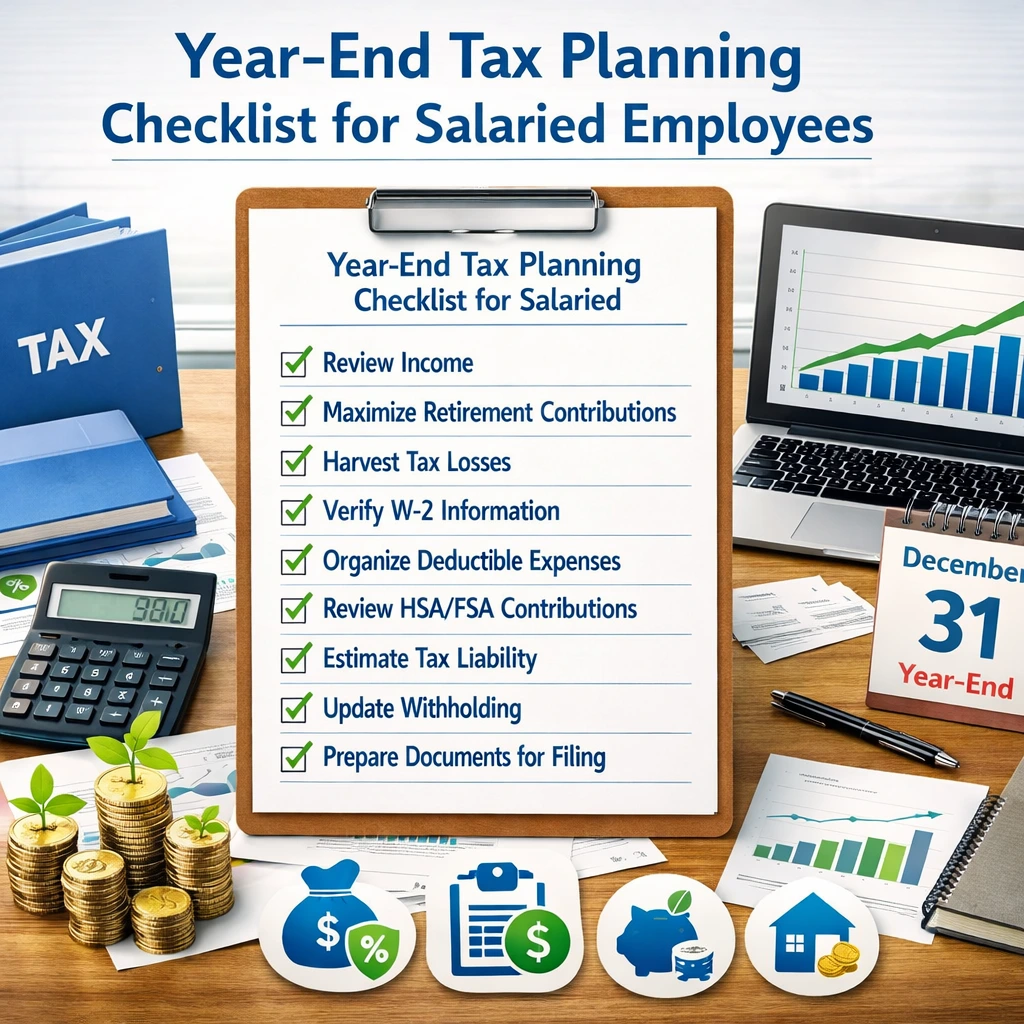
Step 2: Review Health and Flexible Spending Accounts
Health Savings Account (HSA):
- Triple tax advantage: contributions are deductible, growth is tax‑free, and withdrawals for medical expenses are tax‑free.
Flexible Spending Account (FSA):
- Reduces taxable income by letting you pay for medical or childcare expenses pre‑tax.
- Remember: FSA funds usually expire at year‑end, so use them before December 31.
Example: A family in Texas saved $1,800 annually by using their HSA and FSA strategically.
Use the 📊 Monthly Budget Planner to allocate funds for these accounts without straining your monthly cash flow.
(Interlink: Emergency Funds Explained: How to Build Your Ultimate Financial Safety Net)
Step 3: Claim All Available Deductions
Many salaried employees miss out on deductions simply because they don’t track expenses.
Common deductions include:
- Charitable donations
- Mortgage interest
- Student loan interest
- Work‑related education expenses
Example: A teacher in Florida saved $1,200 by claiming continuing education expenses.
(Interlink: Stop Losing Money: 7 Tax Planning Mistakes You Must Avoid)
Step 4: Adjust Your Withholding
If you consistently owe taxes or get large refunds, your withholding may be off.
Fix: Review your W‑4 form annually and adjust based on life changes — marriage, new dependents, or side income.
Example: A software engineer in Seattle reduced his withholding slightly and used the extra monthly cash flow to invest in a Roth IRA.
Step 5: Plan for Bonuses and Extra Income
Year‑end bonuses can push you into a higher tax bracket.
Tips:
- Contribute more to your 401(k) before receiving your bonus.
- Use your bonus for tax‑advantaged investments like HSAs or IRAs.
- Consider charitable donations to offset taxable income.
Use the Debt Payoff Planner to manage bonus allocations between savings and debt repayment.
(Interlink: The Debt Payoff Blueprint: A Step‑by‑Step Plan That Works)
Step 6: Review Investment Gains and Losses
If you’ve sold investments during the year, review your capital gains and losses.
Tax‑Loss Harvesting: Sell losing investments to offset gains elsewhere.
Example: A client used tax‑loss harvesting to offset $5,000 in gains, saving $1,100 in taxes.
(Interlink: How Tax‑Efficient Investing Helps Build Wealth Faster)
Step 7: Organize Documents Early
Don’t wait until April to gather your paperwork. Collect W‑2s, 1099s, mortgage statements, and donation receipts now.
Step 8: Review Insurance and Benefits
Year‑end is the perfect time to review your insurance coverage and employer benefits.
Checklist:
- Update beneficiaries on retirement accounts.
- Review health, life, and disability insurance coverage.
- Check if your employer offers new benefits for the coming year.
Step 9: Plan for Next Year’s Taxes
Tax planning isn’t a one‑time task — it’s a habit that compounds over time.
Example: Laura now reviews her finances every December and saves an average of $3,000 annually.
Start today with the Monthly Budget Planner, Debt Payoff Planner, Side Hustle Starter Kit, Financial Freedom Ebook, and Complete Financial Freedom Toolkit Bundle — your complete system for smarter tax planning and wealth building.
Frequently Asked Questions
Q1: What’s the easiest year‑end tax‑saving step for salaried employees? Start with maximizing your 401(k) contributions — it’s simple and effective.
Q2: Can I invest in both Roth and Traditional IRA? Yes, but your total annual contribution limit applies across both.
Q3: How do I balance debt repayment and tax saving? Use the Complete Financial Toolkit Bundle to visualize both goals side‑by‑side.
Q4: Are HSAs better than FSAs? HSAs roll over annually and can be invested, making them more flexible.
(Interlink: The Credit Card Trap: How Minimum Payments Drain Your Wealth)
Emotional Side of Year‑End Tax Planning
Taxes can feel intimidating, but once you understand how to use them strategically, they become empowering.
Laura once said, “I used to dread tax season. Now, I look forward to seeing how much I’ve saved.” That’s the transformation you deserve — from confusion to confidence.
The Verdict — Save More, Stress Less
Year‑end tax planning isn’t about rushing — it’s about reviewing, adjusting, and preparing. By following this checklist, you’ll not only save money but also start the new year with financial clarity and peace of mind.
Disclaimer
This article is for educational purposes only and does not constitute financial advice. Always consult with a certified tax professional before making investment decisions.
Слушайте кто знает Муж просто умирает на глазах Соседи уже вызвали участкового Платная клиника просит бешеные деньги Короче, единственные кто взялся за безнадёжный случай — вывод из запоя стационар с круглосуточным наблюдением Положили в палату В общем, не потеряйте контакты — запой вывод клиника https://klinika.vyvod-iz-zapoya-v-staczionare-nizhnij-novgorod-srv.ru Звоните прямо сейчас Перешлите тем кто в беде