
1. Introduction
A 401(k) plan is one of the most important retirement-saving tools available to many workers in the United States. It allows eligible employees to contribute money from their paychecks to a workplace retirement account and invest those savings for the future.
The main advantages can include tax benefits, employer matching contributions, and automated payroll contributions. However, a 401(k) is not simply a savings account. The money you contribute is generally invested in options offered by your plan, such as mutual funds, index funds, or target-date funds.
There are also important differences between Traditional 401(k) and Roth 401(k) contributions. Traditional contributions generally provide a tax benefit today, while Roth contributions are made with after-tax money and can provide tax-free qualified distributions later.
How much you can contribute, how employer matching works, what happens when you change jobs, and how withdrawals are taxed all depend on the rules that apply to your plan and the current tax year.
For 2026, the IRS allows employees to contribute up to $24,500 in elective deferrals to a 401(k), subject to the applicable rules. Additional catch-up contributions may be available for eligible older workers.
This guide explains how 401(k) plans work, how Traditional and Roth 401(k)s differ, how employer matching can increase your retirement savings, how to choose investments, and how to avoid common mistakes.
If you’re building your broader retirement strategy, you can also read Retirement Planning in Your 30s: Secure Your Future Better for guidance on building a long-term retirement plan.
2. What Is a 401(k)?
A 401(k) is an employer-sponsored retirement plan that allows eligible employees to save and invest money through payroll contributions. The money is placed into the retirement account according to the employee’s contribution election and can then be invested in the options offered by the plan.
One of the main advantages of a 401(k) is the opportunity to receive tax benefits while saving for retirement. The exact tax treatment depends on whether you make Traditional 401(k) contributions, Roth 401(k) contributions, or both.
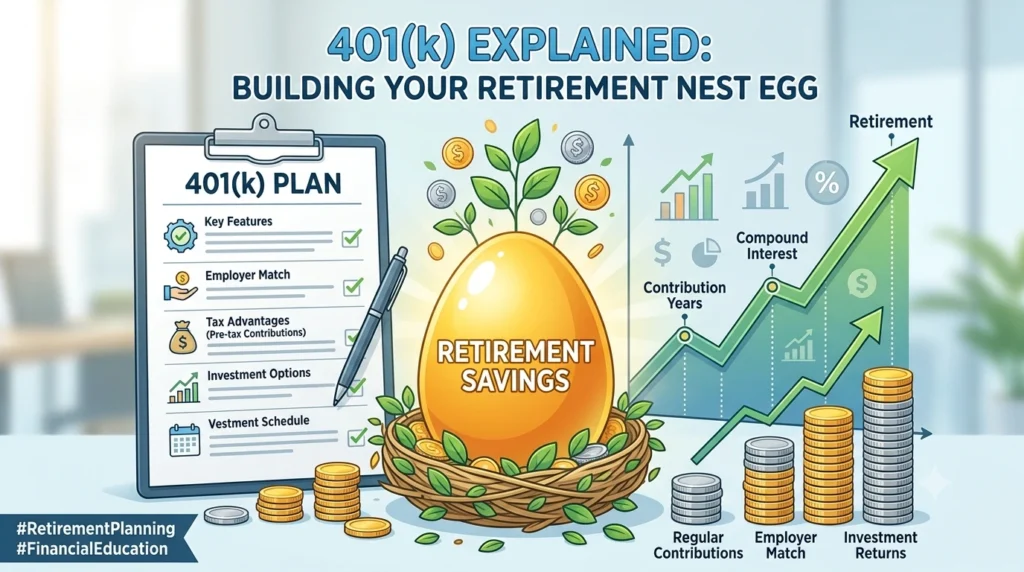
Key features of a 401(k)
- Payroll contributions: Contributions are generally deducted directly from your paycheck, making retirement saving automatic.
- Employer contributions: Some employers contribute matching or other contributions to employees’ accounts, subject to the terms of the plan.
- Investment options: Your contributions can generally be invested among the investment choices available through your employer’s plan.
- Tax advantages: Traditional and Roth 401(k) contributions receive different tax treatment.
- Higher contribution limits: 401(k) plans generally allow substantially higher annual employee contributions than IRAs.
For example, suppose you earn $60,000 per year and choose to contribute $6,000 to a Traditional 401(k). That contribution generally reduces the wages subject to federal income tax for the year. However, it generally does not eliminate Social Security and Medicare taxes on those wages.
The amount you ultimately accumulate depends not only on how much you contribute, but also on employer contributions, investment performance, fees, and how long the money remains invested.
A 401(k) is therefore best understood as a retirement account with tax advantages and an investment component, rather than an investment by itself. The investments available inside the plan still need to be evaluated based on your goals, time horizon, and risk tolerance.
3. Traditional 401(k) vs. Roth 401(k)
Many employers offer employees a choice between Traditional 401(k) and Roth 401(k) contributions. Both can help you save for retirement, but they provide their main tax benefits at different stages.
Traditional 401(k)
Traditional 401(k) contributions are generally made with pre-tax money. Your contribution can reduce the amount of your wages subject to federal income tax for the year, while withdrawals are generally taxable later.
The potential advantage is receiving the tax benefit today while allowing your retirement savings to remain invested.
Roth 401(k)
Roth 401(k) contributions are made with after-tax money, so you generally don’t receive a federal income-tax deduction for the contribution.
However, qualified distributions from a Roth 401(k) can generally be tax-free. This can make a Roth 401(k) attractive to someone who expects their tax rate in retirement to be similar to or higher than their current rate.
Traditional vs. Roth 401(k)
| Feature | Traditional 401(k) | Roth 401(k) |
|---|---|---|
| Contributions | Generally pre-tax | After-tax |
| Federal income-tax deduction today | Generally yes | No |
| Investment growth | Generally tax-deferred | Generally tax-free when distributed as part of a qualified distribution |
| Qualified retirement withdrawals | Generally taxable | Generally tax-free |
| Income restrictions on employee contributions | Generally no income limit for making elective deferrals | Generally no income limit for making designated Roth contributions |
| Main tax advantage | Potential tax benefit today | Potential tax-free qualified withdrawals later |
You don’t necessarily have to choose one type permanently. If your employer’s plan permits both, your contribution strategy can change as your income, tax situation, and retirement expectations change.
For example, a worker in a relatively low current tax bracket might favor Roth contributions if they expect their income and tax rate to increase over time. A worker in a higher current tax bracket may place greater value on the immediate tax benefit from Traditional 401(k) contributions.
These are general considerations, not universal rules. Your current tax rate, expected retirement income, other retirement accounts, and overall financial plan should all be considered.
For a detailed comparison of the related IRA choices, see Traditional IRA vs Roth IRA: Which Retirement Account Is Better?.
4. Employer Matching: One of the Biggest 401(k) Benefits
One of the most valuable features of many 401(k) plans is an employer matching contribution. An employer match means your employer contributes additional money to your 401(k) based on how much you contribute, according to the plan’s matching formula.
For example, suppose you earn $60,000 per year and your employer matches 50% of your contributions up to 6% of your salary:
- Your 6% contribution = $3,600
- Employer match at 50% = $1,800
- Total contributed to your account = $5,400
That employer contribution can significantly increase the amount going toward retirement without requiring you to contribute the entire amount yourself.
Don’t leave an available match unused
If your employer offers a match, understand the exact formula and contribute enough to receive the full available match, if doing so fits your financial situation.
However, don’t assume every employer uses the same formula. Some plans may match a percentage of your contributions up to a certain percentage of your salary, while others use different formulas or contribution structures.
Understand vesting
Employer contributions may also be subject to a vesting schedule. Vesting determines how much of the employer’s contributions you are entitled to keep if you leave the company.
Your own 401(k) contributions are generally always yours, but unvested employer contributions may be forfeited when you leave, depending on the plan’s rules.
Check your employer’s Summary Plan Description (SPD) or plan documents to understand the matching formula and vesting requirements.
The employer match is therefore more than a bonus—it can be an important part of your total retirement compensation. Understanding the rules and capturing the available match can help you make better use of your workplace retirement plan.
5. 401(k) Contribution Limits: 2026 Update
For 2026, the employee contribution limit for most 401(k) plans is $24,500 in elective deferrals.
Workers who are age 50 or older by the end of the applicable tax year may generally make an additional $8,000 catch-up contribution, bringing the total to $32,500.
There is also a higher catch-up contribution for certain participants who are age 60, 61, 62, or 63 during 2026. For those eligible participants, the catch-up limit is $11,250 instead of $8,000.
2026 401(k) employee contribution limits
| Age during 2026 | Regular contribution | Catch-up contribution | Potential total |
|---|---|---|---|
| Under 50 | $24,500 | — | $24,500 |
| 50–59 or 64+ | $24,500 | $8,000 | $32,500 |
| 60–63 | $24,500 | $11,250 | $35,750 |
These limits generally apply to your combined Traditional 401(k) and Roth 401(k) elective deferrals within the applicable plan or plans, rather than providing a separate $24,500 limit for each type.
Your employer’s matching contributions are treated differently from your employee elective deferrals and are subject to separate overall plan limits.
Because contribution limits and catch-up rules can change, check the IRS 401(k) contribution-limit guidance for the applicable tax year.
The important point is that you don’t need to reach the maximum to benefit from a 401(k). A consistent contribution that captures an available employer match can be a strong starting point, and you can consider increasing your contribution rate as your income grows.
6. Tax Advantages of a 401(k)
One of the main reasons people use 401(k) plans is their favorable tax treatment. The tax benefit depends on whether you contribute to a Traditional 401(k), a Roth 401(k), or both.
Traditional 401(k) tax treatment
Traditional 401(k) contributions are generally made on a pre-tax basis for federal income-tax purposes, which can reduce your taxable wages for the year.
For example, if you earn $80,000 and contribute $8,000 to a Traditional 401(k), that $8,000 generally isn’t included in your wages for current federal income-tax purposes. However, it generally remains subject to Social Security and Medicare taxes.
The money can then remain invested in the account without you generally paying annual federal income tax on investment gains and income. When you eventually take taxable distributions, those amounts are generally subject to income tax.
Roth 401(k) tax treatment
Roth 401(k) contributions are made with after-tax money, so you generally don’t receive an upfront federal income-tax deduction.
The potential benefit comes later. If the distribution meets the requirements for a qualified Roth 401(k) distribution, the distribution can generally be tax-free.
This creates an important distinction:
Traditional 401(k): potential tax benefit now → generally taxable distributions later.
Roth 401(k): taxes paid now → potentially tax-free qualified distributions later.
Neither approach is automatically better. The more appropriate choice depends on factors such as your current tax bracket, expected retirement income, expected future tax rates, and overall retirement strategy.
Also remember that tax savings do not mean the investment itself is risk-free. The money inside your 401(k) is still invested in the options offered by your plan, and its value can rise or fall with market performance.
7. Choosing Investments Inside Your 401(k)
Contributing to a 401(k) is only one part of retirement planning. You also need to decide how the money in your account will be invested.
The investment choices available depend on your employer’s plan. Common options can include:
- Target-date funds
- Stock mutual funds
- Bond funds
- Index funds
- Stable-value or other conservative investments
Consider your retirement timeline
Your investment mix should reflect factors such as your time horizon, risk tolerance, and retirement goals.
Someone with several decades until retirement may have more time to tolerate market fluctuations and may choose a portfolio with greater exposure to stocks. Someone approaching retirement may place greater emphasis on managing volatility and preserving capital.
A target-date fund can be a convenient option for investors who want a professionally managed portfolio that generally becomes more conservative as the target retirement date approaches.
Don’t ignore fees
Investment expenses can reduce your long-term returns. When comparing the investment choices in your 401(k), look at the expense ratio and other plan-related fees, not just recent performance.
A fund that performed well recently is not automatically the best choice for your retirement portfolio.
Diversification still matters
Avoid putting all of your retirement savings into a single investment or narrowly focused fund simply because it performed well in the past.
Diversifying across appropriate asset classes can help manage investment risk. Your asset allocation should be consistent with your retirement timeline and ability to tolerate market declines.
For a broader explanation of diversification and how it can help manage investment risk, see The Power of Diversification: How Smart Investors Reduce Risk.
The goal isn’t to find the investment with the highest recent return. It’s to build an investment mix that you can maintain consistently through different market conditions while working toward your long-term retirement objective.
8. How to Build Your 401(k) Strategically
A strong 401(k) strategy is not simply about contributing as much as possible. It is about contributing consistently, taking advantage of available employer benefits, choosing appropriate investments, and increasing your savings over time.
Start by capturing the employer match
If your employer offers matching contributions, consider contributing enough to receive the full available match, provided it fits your financial situation. This can give your retirement savings an immediate boost.
Increase contributions gradually
You don’t have to reach the annual maximum immediately. A practical approach is to start with an affordable contribution rate and increase it when your salary rises, you receive a bonus, or your regular expenses decrease.
Even small increases in your contribution rate can make a meaningful difference over a long investment period.
Automate your retirement savings
Because 401(k) contributions are generally deducted directly from your paycheck, the process is already automated. This reduces the temptation to spend money that you intended to save.
Review your investment allocation
Your contribution rate is only one part of the strategy. Review the investments available through your plan and make sure your allocation remains appropriate for your retirement timeline and risk tolerance.
You don’t necessarily need to change investments frequently. Excessive trading or reacting emotionally to short-term market movements can work against a long-term retirement strategy.
Rebalance when appropriate
Over time, market movements can cause your portfolio to drift away from your intended asset allocation. Periodic rebalancing can help bring your portfolio back toward your target mix.
The goal is to create a repeatable retirement-saving system rather than constantly trying to predict which investment will perform best next. Consistent contributions, appropriate diversification, and disciplined investing can matter more than short-term market timing. For a broader strategy that combines retirement saving with long-term investing, see How to Save for Retirement While Investing: Better Explained.
9. What Happens to Your 401(k) When You Change Jobs?
Changing jobs does not mean you have to cash out your 401(k). In many cases, you have several options for handling the money you’ve accumulated in your former employer’s plan.
Option 1: Leave the money in your former employer’s plan
Depending on the plan’s rules and your account balance, you may be able to leave your money in the former employer’s 401(k).
This can be convenient because you don’t have to move the account immediately. However, you should review the plan’s investment choices, fees, and services to determine whether keeping the account there makes sense.
Option 2: Roll the money into your new employer’s 401(k)
If your new employer’s plan accepts rollovers, you may be able to transfer your old 401(k) balance into the new plan.
This can consolidate your retirement savings into one account and may make it easier to manage your investments.
Option 3: Roll the money into an IRA
You may also be able to roll an eligible 401(k) balance into an IRA. This can provide access to a broader range of investment choices, although fees and tax considerations should be evaluated before making the decision.
A rollover from a Traditional 401(k) to a Traditional IRA is generally different from converting the money to a Roth IRA. A Roth conversion can create taxable income and should not be treated as a routine rollover.
Option 4: Take the money as a distribution
Cashing out your 401(k) may provide immediate access to the money, but it can have significant tax consequences and may trigger an additional tax if you’re below the applicable age and no exception applies.
It can also remove money from a retirement account where it could otherwise remain invested for the future.
Don’t rush the decision
When changing jobs, compare your options based on:
- Investment choices
- Account fees
- Employer-plan features
- Tax consequences
- Your overall retirement strategy
- Whether consolidation would make your accounts easier to manage
A job change can therefore be a good opportunity to review your retirement accounts, but cashing out your old 401(k) should not be treated as the default option.
10. 401(k) Withdrawals, Loans, and Required Minimum Distributions
A 401(k) is designed primarily for retirement, so taking money out before retirement can have tax consequences. The rules depend on the type of contribution, your age, the reason for the distribution, and the specific terms of your plan.
Early withdrawals
If you take money from a 401(k) before age 59½, the distribution may generally be subject to ordinary income tax and an additional 10% tax, unless an exception applies.
Some exceptions can apply in specific circumstances, so don’t assume that every early distribution will automatically receive the same tax treatment.
401(k) loans
Some 401(k) plans allow participants to borrow from their accounts. A loan isn’t automatically a bad decision, but it should be considered carefully.
Taking a loan can reduce the amount of money remaining invested for retirement. It can also create complications if you leave your employer while the loan is outstanding or fail to follow the repayment requirements.
Before taking a 401(k) loan, understand your plan’s rules, repayment requirements, interest, and potential tax consequences.
Required minimum distributions
Traditional 401(k) accounts are generally subject to required minimum distribution (RMD) rules once you reach the applicable age under current law, although exceptions and special rules can apply.
Designated Roth 401(k) accounts are treated differently. Roth 401(k) accounts are no longer subject to lifetime RMDs for the original account owner, beginning under the applicable SECURE 2.0 rules.
Because RMD requirements depend on factors such as your birth year, employment status, and account type, check the current IRS guidance on required minimum distributions before deciding when and how much to withdraw.
The key takeaway is simple: avoid treating your 401(k) as an ordinary savings account. The account is designed for long-term retirement savings, and withdrawals should be considered in the context of taxes, penalties, investment growth, and your overall retirement plan.
11. Common 401(k) Mistakes to Avoid
Even a well-designed retirement plan can lose effectiveness if you overlook a few important details.
1. Contributing less than the amount needed for the full employer match
If your employer offers matching contributions, understand the matching formula and consider contributing enough to receive the full available match, if it fits your financial situation.
2. Choosing investments based only on recent performance
A fund that performed well recently isn’t necessarily the right investment for your retirement portfolio. Consider your time horizon, risk tolerance, diversification, and investment costs.
3. Ignoring investment fees
Even relatively small investment expenses can reduce long-term returns. Review the expense ratios and other fees associated with the investment options available in your plan.
4. Treating a 401(k) loan as free money
A 401(k) loan gives you access to money in your retirement account, but it can reduce the amount remaining invested for retirement and may create additional complications if you leave your employer.
Understand the repayment requirements and potential consequences before taking a loan.
5. Cashing out when changing jobs
Taking a distribution from an old 401(k) may create taxes and potentially additional penalties while removing money from long-term retirement savings.
Before cashing out, compare leaving the money in the old plan, rolling it into a new employer’s plan, or completing an eligible rollover to an IRA.
6. Failing to increase contributions over time
Your initial contribution rate doesn’t have to remain unchanged forever. Consider increasing your contribution when your salary rises or your financial circumstances improve.
7. Ignoring your overall retirement strategy
A 401(k) is only one part of retirement planning. Consider it alongside your IRA, other investments, emergency savings, expected retirement income, and long-term goals.
The goal isn’t simply to maximize your 401(k) contribution at any cost. It’s to build a sustainable retirement strategy that balances saving, investing, taxes, risk, and your other financial priorities.
12. Frequently Asked Questions About 401(k) Plans
Can I have both a 401(k) and an IRA?
Yes. You can contribute to a 401(k) and an IRA in the same year, subject to the separate rules and limits that apply to each account.
However, contributing to a 401(k) can affect whether a Traditional IRA contribution is deductible, depending on your income, filing status, and workplace retirement-plan coverage. Roth IRA contributions also have their own income-based eligibility rules.
Is a 401(k) better than an IRA?
Neither is universally better.
A 401(k) generally offers higher employee contribution limits and may provide an employer match. An IRA can offer access to a broader range of investments and can complement a workplace retirement plan.
For many investors, using both can make sense as part of an overall retirement strategy.
Can I contribute to both a Traditional and Roth 401(k)?
If your employer’s plan allows both contribution types, you can generally contribute to Traditional and Roth 401(k) accounts in the same year.
Your combined employee elective deferrals are subject to the applicable annual 401(k) contribution limit.
What happens to my 401(k) when I change jobs?
You generally have several options, depending on your circumstances and the plans involved. You may be able to leave the money in your former employer’s plan, roll it into your new employer’s plan, roll it into an IRA, or take a distribution.
Each option has different investment, administrative, and tax considerations.
Can I withdraw money from my 401(k) before age 59½?
You may be able to take an early distribution, but it can generally result in income tax and an additional 10% tax unless an exception applies.
The specific rules depend on the circumstances of the distribution and your plan.
Should I choose a Traditional or Roth 401(k)?
It depends on your tax situation and retirement goals.
A Traditional 401(k) can provide a potential tax benefit today, while a Roth 401(k) can provide the potential for tax-free qualified distributions later.
Rather than assuming one is always better, consider your current tax rate, expected retirement income, future tax situation, and other retirement accounts.
How much should I contribute to my 401(k)?
There is no single percentage that works for everyone.
A practical starting point is to contribute enough to capture the full employer match when possible. From there, you can consider increasing your contribution rate as your income grows and your financial situation allows.
The most important thing is to establish a contribution level you can maintain consistently while also meeting your other financial obligations and goals.
13. Verdict: How to Make the Most of Your 401(k)
A 401(k) can be one of the most valuable tools for building long-term retirement wealth, particularly when your employer provides matching contributions.
The most effective approach is not necessarily to contribute the maximum immediately. Instead, focus on building a consistent and sustainable retirement strategy:
- Contribute enough to capture the full employer match when possible.
- Understand the differences between Traditional and Roth 401(k) contributions.
- Increase your contribution rate as your income and financial capacity grow.
- Choose investments that match your retirement timeline and risk tolerance.
- Pay attention to investment fees and diversification.
- Review your account periodically without reacting to every short-term market movement.
- Understand your options before taking a withdrawal, loan, or rollover.
- Consider your 401(k) alongside your IRA and other retirement investments.
The biggest advantage of a 401(k) is the combination of long-term investing, tax advantages, employer contributions, and automatic payroll saving. Used consistently over many years, these features can help turn regular contributions into a substantial retirement portfolio.
The goal isn’t to make your 401(k) complicated. Start with a contribution you can sustain, use the benefits available through your employer, invest appropriately for your time horizon, and increase your savings as your financial situation improves.
Disclaimer
This article is for educational purposes only and does not constitute financial advice. Always consult with a certified financial advisor before making investment decisions.