

Introduction – What Does It Really Mean to Invest Safely?
Learning how to invest safely does not mean eliminating investment risk. Every investment carries some level of risk, and even diversified portfolios can lose value when markets fall. The goal is to understand the risks you’re taking, match them to your financial goals and time horizon, and avoid risks you don’t need to take.
For most U.S. beginners, safe investing starts before buying a single stock or fund. You need a financial foundation, a clear investment goal, an appropriate account, a diversified portfolio, and a strategy you can stick with when markets become unpredictable.
Consider a simple example. Someone saving for a home down payment in two years has a very different need from someone investing for retirement 30 years away. Putting both goals into the same high-risk portfolio would not necessarily be a safe strategy—even if the investments themselves are good.
This guide explains 10 practical strategies for investing safely, including how to manage risk, diversify your investments, control fees, use tax-advantaged accounts, protect your money from scams, and stay disciplined during market downturns.
Important: There is no investment that is completely risk-free while also guaranteeing high returns. Safe investing is about making informed decisions and taking an appropriate amount of risk—not avoiding investing altogether.
A Practical Example of Investing Safely
Imagine David, a 42-year-old IT professional in Austin, Texas. He has been investing for several years, but most of his portfolio is concentrated in technology stocks. He also has limited emergency savings and no clear investment plan.
Instead of trying to find the next high-performing investment, David decides to take a more structured approach. He builds an emergency fund, pays down high-interest debt, reviews his investment time horizon, diversifies across different investments, and chooses lower-cost funds for his long-term goals.
He also decides how much market volatility he can realistically tolerate and establishes a regular contribution schedule rather than making investment decisions based on daily headlines.
This is a hypothetical example, not a real client case. The point is that investing safely is less about finding a “safe” investment and more about building a financial plan that limits unnecessary risks.
Investor.gov — Introduction to Investing
(Interlink: The Power of Diversification: How Smart Investors Reduce Risk)
1. Start with a Solid Financial Foundation
Before putting money into the market, make sure your basic financial foundation is strong. Investing can help build long-term wealth, but it shouldn’t come at the expense of money you’ll need for an emergency or high-interest debt that is growing faster than your investments.
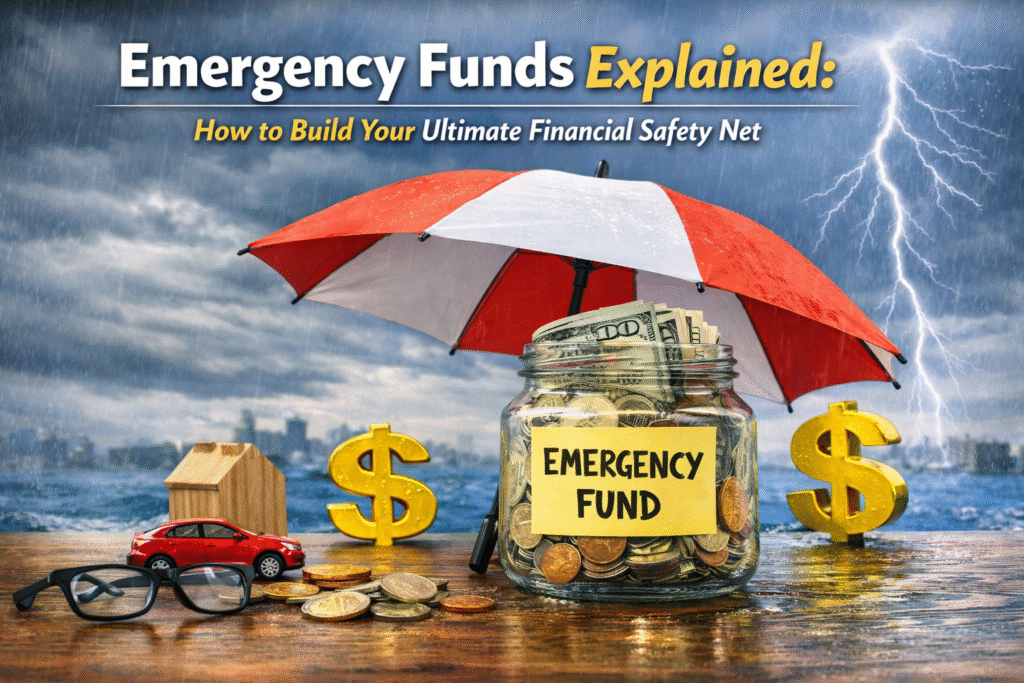
Build an Emergency Fund
An emergency fund is money set aside for unexpected expenses such as a job loss, major car repair, medical bill, or urgent home expense. Keeping this money in an accessible savings account can help you avoid selling investments when markets are down.
A common starting point is three to six months of essential living expenses, although the right amount depends on your income stability, household situation, and financial obligations.
For example, if your essential expenses are $3,000 per month, an emergency-fund target of $9,000 to $18,000 could provide a reasonable starting range.
If you’re still building your emergency fund, don’t feel pressured to invest every available dollar. Establishing a cash reserve first can make it easier to stay invested when the stock market becomes volatile.
Related: [Emergency Funds Explained: How to Build Your Ultimate Financial Safety Net]
Deal With High-Interest Debt
Before investing aggressively, look at expensive debt—particularly credit card balances with high interest rates.
For example, if a credit card charges 20% or more in annual interest, paying down that balance can provide a predictable financial benefit that is difficult for a normal investment to match consistently.
That doesn’t necessarily mean you must eliminate every debt before investing. A person might contribute enough to a workplace 401(k) to receive an available employer match while simultaneously working to eliminate high-interest debt.
The key is to consider the interest rate, tax treatment, employer benefits, and your overall financial situation rather than following a one-size-fits-all rule.
Related: [The Credit Card Trap: How Minimum Payments Drain Your Wealth]
Define What the Money Is For
Finally, give every investment a purpose.
Money intended for a retirement goal decades away can generally tolerate more market volatility than money you’ll need for a house down payment next year.
Before investing, write down:
- What is this money for?
- When will I need it?
- How much could I afford to lose temporarily without abandoning my plan?
These answers will influence the type of account, investments, and risk level that make sense for you.
Organize Your Finances Before Investing
If you’re struggling to find money to invest consistently, the Monthly Budget Planner can help you track your spending, identify unnecessary expenses, and create room for regular investing.

2. Diversify Your Portfolio to Reduce Unnecessary Risk
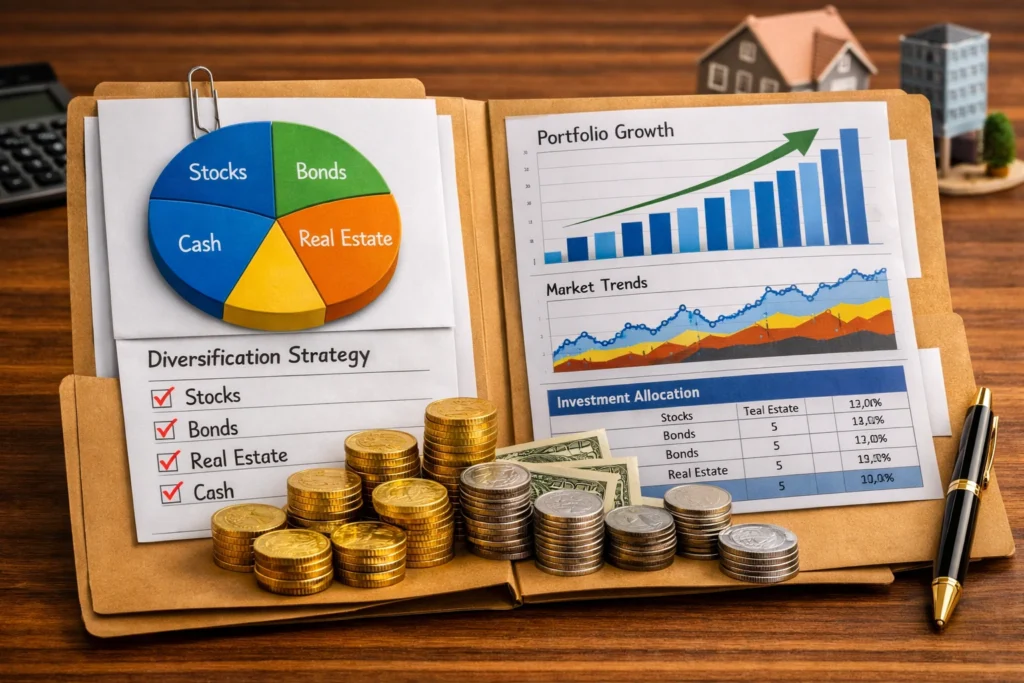
Diversification means spreading your investments so that your financial future doesn’t depend too heavily on a single company, sector, asset class, or market.
Imagine putting your entire $20,000 investment into one technology stock. If that company suffers a major setback, your entire portfolio could fall sharply. Owning a broader mix of investments can reduce the impact of any one investment performing poorly.
Diversify Across Different Investments
Depending on your goals and risk tolerance, diversification can involve a combination of:
- U.S. stocks for long-term growth potential
- International stocks for exposure to companies outside the United States
- Bonds for income and potentially lower volatility
- Cash or cash equivalents for short-term needs and liquidity
- Real estate exposure where appropriate
You don’t necessarily need dozens of individual investments to achieve diversification. A broadly diversified mutual fund or ETF can hold many securities within a single investment.
For example, instead of putting $10,000 into one technology company, a beginner might use a broadly diversified stock index fund that owns shares of hundreds of companies.
However, diversification doesn’t eliminate risk. A broad stock-market fund can still lose significant value during a market downturn.
Don’t Confuse Diversification With Owning More Investments
Buying five different technology stocks doesn’t necessarily create meaningful diversification if all five companies are affected by the same economic or industry risks.
Similarly, owning several funds doesn’t guarantee that your portfolio is diversified if those funds hold many of the same companies.
When reviewing your portfolio, look beyond the number of investments and ask:
What do I actually own, and how much of my portfolio depends on each type of risk?
A Simple Example
Suppose an investor has a long-term retirement goal and wants a portfolio built around diversified investments.
Instead of trying to select the next winning stock, the investor could combine broadly diversified stock and bond funds according to their time horizon and risk tolerance.
The exact allocation isn’t the same for everyone. Someone investing for retirement 30 years away may have a very different allocation from someone who expects to use the money within five years.
Related: [The Power of Diversification: How Smart Investors Reduce Risk]
Related: [How to Build a Strong Portfolio: Smart Diversification Tips]
3. Invest for the Long Term
One of the simplest ways to reduce the risk of making emotional investment decisions is to give your investments enough time to work toward your goals.
Stock markets can experience significant declines over short periods. If you need the money soon, a large market decline could force you to sell when prices are lower. But money intended for a long-term goal may have more time to recover from temporary market declines.
Match Your Investments to Your Time Horizon
Consider how soon you’ll need the money:
- Short term: Money needed within the next few years generally deserves a more conservative approach because you have less time to recover from a market decline.
- Medium term: For goals several years away, a combination of growth and stability may be appropriate depending on your circumstances.
- Long term: Money intended for goals such as retirement decades away may have more capacity to withstand short-term market volatility.
For example, someone saving for retirement 30 years from now can generally think differently about a temporary 20% stock-market decline than someone who needs their entire investment portfolio for a home purchase next year.
Don’t Confuse Long-Term Investing With Ignoring Your Portfolio
Long-term investing doesn’t mean buying something and never looking at it again.
You should still:
- Review your goals periodically.
- Check whether your asset allocation still fits your situation.
- Rebalance when appropriate.
- Review investment fees.
- Increase contributions when your financial situation allows.
- Make changes when your goals or circumstances change.
The objective is to avoid reacting emotionally to normal market fluctuations while still managing your portfolio responsibly.
Let Compounding Work Over Time
Time can also make a major difference because investment returns can generate additional returns when they remain invested.
For example, investing $300 per month for 30 years would mean contributing $108,000 of your own money. If the investments generated an average annual return of 7% and the returns were reinvested, the account could grow to roughly $366,000 before taxes and fees.
That example is an illustration, not a guaranteed result. Actual investment returns vary from year to year, and you can lose money.
Related: [Compound Interest Explained: How to Turn Small Savings Into Wealth]
Stay Invested, But Stay Rational
Long-term investing doesn’t guarantee profits. It simply gives your investments more time to potentially benefit from economic growth and compounding.
The key is to choose a strategy you can realistically maintain during both rising and falling markets.
4. Choose Diversified, Low-Cost Investments
For many beginners, broadly diversified index funds and ETFs can provide a simple way to invest across many companies without having to research and select individual stocks.
An index fund is designed to track a particular market index. An ETF (exchange-traded fund) is a type of investment fund that trades on an exchange during the trading day. An ETF can be an index fund, but not every ETF is an index fund.
Why Investment Costs Matter
Investment fees may look small, but they can reduce your returns over many years.
One common cost is the expense ratio, which represents the annual operating expenses charged by a fund as a percentage of its assets.
For example:
- A 0.05% expense ratio on a $10,000 investment is about $5 per year.
- A 1.00% expense ratio on the same $10,000 is about $100 per year.
The difference may seem small at first, but fees can have a much larger impact when an investment grows over decades.
Don’t choose a fund based solely on its expense ratio, however. Also consider:
- What index or strategy it follows
- What investments it holds
- How diversified it is
- Its historical tracking of the underlying index
- Trading costs or other account fees
- Whether it fits your investment goal
Avoid Assuming the Cheapest Fund Is Automatically the Best
A lower expense ratio is generally helpful when comparing otherwise similar investments, but cost isn’t the only consideration.
For example, two funds could have similar fees but very different investment strategies and levels of diversification.
Before investing, read the fund’s description and understand what you are actually buying.
Related: [Index Funds vs ETFs: Which Is the Best Option?]
Related: [Tax-Efficient Investing: How to Build Wealth While Reducing Taxes]
5. Avoid Emotional Investing
Market volatility can test even a well-designed investment plan. When prices fall sharply, fear can make investors want to sell everything. When prices rise rapidly, excitement can encourage people to chase investments after they’ve already increased substantially.
Both reactions can lead to poor decisions.
Don’t Try to Predict Every Market Move
No one can consistently predict when the market will reach its highest or lowest point.
Instead of trying to decide whether today is the perfect day to invest, create a strategy you can follow through different market conditions.
For example, you might:
- Invest a fixed amount regularly.
- Maintain an emergency fund outside your investment portfolio.
- Diversify your investments.
- Decide on an appropriate asset allocation in advance.
- Review your portfolio periodically rather than reacting to daily headlines.
What Should You Do During a Market Crash?
A market decline doesn’t automatically mean that your investment strategy has failed.
Before selling an investment because its price has fallen, ask:
- Has my financial goal changed?
- Has my time horizon changed?
- Has my ability to tolerate investment losses changed?
- Has something fundamentally changed about the investment itself?
If the answer to these questions is no, selling purely because prices have fallen may be an emotional reaction rather than a planned investment decision.
However, “stay invested” is not a universal rule. If you discover that your portfolio is taking more risk than you can realistically tolerate, changing your allocation may be appropriate.
Be Careful When Markets Are Rising Too
Emotional investing isn’t limited to market crashes.
During periods of strong market performance, investors may feel pressure to buy whatever has recently performed well. This is sometimes called performance chasing.
Before buying an investment, understand:
- What you are buying
- Why you are buying it
- How much of your portfolio it represents
- What could cause it to lose value
- Whether it fits your investment goal and time horizon
A written investment plan can make these decisions easier because you establish your rules before emotions take over.
Related: [Dollar-Cost Averaging Explained: The Smart Way to Invest]
6. Understand Your Risk Tolerance and Risk Capacity
Investing safely starts with understanding how much risk you can realistically handle.
Two people with the same age and income may need very different investment strategies because their goals, financial circumstances, and ability to tolerate losses can be different.
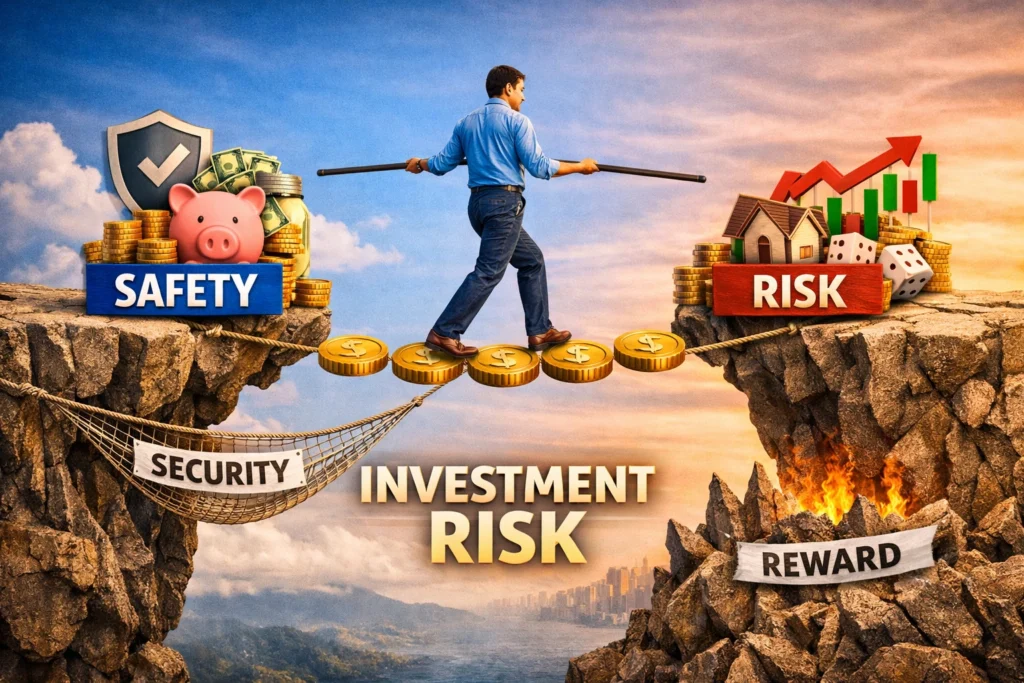
Risk Tolerance vs. Risk Capacity
These terms sound similar, but they aren’t exactly the same.
Risk tolerance is your psychological ability to handle investment losses.
For example, imagine your portfolio falls 20% during a market downturn. Would you be able to remain invested according to your plan, or would the decline cause you to sell because you couldn’t tolerate the uncertainty?
Risk capacity is your financial ability to withstand a loss.
Someone with a stable income, substantial emergency savings, little debt, and a long investment horizon may have greater capacity to tolerate market volatility than someone who depends on the investment money for an upcoming expense.
Your investment strategy should consider both.
Time Horizon Matters
The amount of time you have before you need the money is another major factor.
For example:
- Money needed within a few years: You generally have less time to recover from a market decline, so preserving capital and maintaining liquidity may be more important.
- Money needed in 5–10 years: You may have more flexibility, but the appropriate mix depends on the goal and your ability to tolerate losses.
- Money intended for retirement decades away: A long time horizon may allow you to accept more short-term volatility in exchange for greater long-term growth potential.
There is no single stock-and-bond allocation that is right for everyone.
Ask Yourself These Questions
Before choosing an investment strategy, consider:
- When will I need this money?
- What is the purpose of this investment?
- How much could I afford to lose temporarily?
- Would a large decline cause me to sell in panic?
- Do I have an emergency fund outside my investment portfolio?
- Do I have high-interest debt that should receive priority?
- Is my income stable enough to continue investing during a downturn?
Your answers can help determine whether your investment strategy is taking an appropriate amount of risk.
Related: [Savings or Investments? How to Strike the Right Balance]
Related: [Mastering Risk in Investments: How-to Guide for Beginners]
7. Use Tax‑Advantaged Accounts When They Fit Your Goals
For U.S. investors, choosing the right account can be almost as important as choosing the investment itself.
A retirement account is the container that provides certain tax advantages. The investments—such as stocks, bonds, mutual funds, or ETFs—are what you hold inside that account.
401(k) and Similar Workplace Plans
If your employer offers a 401(k), check whether the company provides an employer match.
An employer match can be an important benefit because the employer contributes money to your retirement account based on your contributions, subject to the plan’s rules.
For 2026, the employee contribution limit for most 401(k) plans is $24,500. Employees who are age 50 or older may generally be eligible for an additional $8,000 catch-up contribution, while a higher $11,250 catch-up limit applies to certain employees ages 60 through 63.
Your employer’s plan may have additional rules or lower limits, so check the plan documents.
Traditional IRA
Contributions to a Traditional IRA may provide a tax deduction if you meet the applicable requirements. Money in the account generally grows tax-deferred, while withdrawals are generally taxable as income.
For 2026, the combined contribution limit for your Traditional and Roth IRAs is $7,500, or $8,600 if you’re eligible for the age-50-or-older catch-up contribution.
Whether a Traditional IRA contribution is deductible can depend on factors such as your income, filing status, and whether you or your spouse participates in a workplace retirement plan.
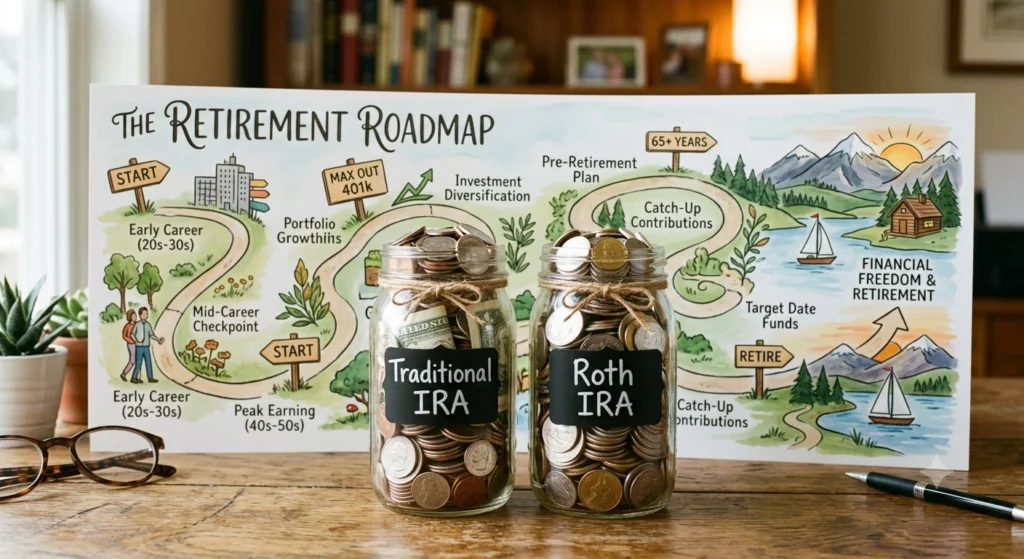
Roth IRA
Roth IRA contributions are made with after-tax money. Qualified withdrawals can generally be tax-free, provided the applicable requirements are met.
However, Roth IRA eligibility can be affected by income. For 2026, the IRS lists a Roth IRA contribution phase-out range of $153,000–$168,000 for single filers and heads of household, and $242,000–$252,000 for married couples filing jointly.
Health Savings Account (HSA)
If you’re eligible for an HSA, it can also provide significant tax advantages when used according to the applicable rules.
For 2026, the HSA contribution limit is $4,400 for self-only coverage and $8,750 for family coverage.
An HSA isn’t a replacement for an emergency fund or retirement account, but eligible investors may use it as part of a broader tax-efficient financial strategy.
Don’t Choose an Account Based on Taxes Alone
Tax advantages are important, but your decision should also consider:
- Your financial goal
- Your income and tax situation
- When you expect to need the money
- Employer matching opportunities
- Contribution limits
- Withdrawal rules
- Investment choices available inside the account
For example, a workplace 401(k) with an employer match may deserve attention before opening another account, while a Roth IRA may offer useful tax diversification for someone who qualifies.
The right approach depends on your individual circumstances.
Related: [401(k) Explained: How to Build Wealth and Save on Taxes]
Related: [Traditional IRA vs Roth IRA: Which Retirement Account Is Better?]
Related: [How Tax-Efficient Investing Helps Build Wealth Faster]
8. Rebalance Your Portfolio When Needed
Over time, some investments will grow faster than others. As a result, your portfolio can gradually move away from the asset allocation you originally chose.
Rebalancing means bringing your portfolio back toward its intended allocation. This can help prevent your portfolio from taking more—or less—risk than you originally planned.
A Simple Example
Suppose you decide that a particular long-term portfolio should contain:
- 60% stocks
- 40% bonds
After a strong period for stocks, your portfolio might eventually become 70% stocks and 30% bonds.
You could then consider rebalancing toward your original allocation by:
- Selling some of the overweight investment and buying the underweight investment.
- Directing new contributions toward the underweight investment.
- Using a combination of both approaches.
You don’t necessarily have to sell investments every time you rebalance. Using new contributions to bring an underweight part of your portfolio back toward its target can sometimes reduce the need to sell.
How Often Should You Rebalance?
There isn’t a universal schedule that works for everyone.
Some investors review their allocation every six or twelve months, while others rebalance only when an asset class moves beyond a predetermined percentage or percentage-point range.
The important point is to establish a reasonable approach before market movements tempt you to make emotional decisions.
Also consider potential tax consequences and transaction costs before selling investments in a taxable account.
Related: [Asset Allocation Explained: The Secret to Long-Term Investing]
9. Keep enough Liquidity for Your Needs
Liquidity refers to how easily and quickly you can convert an investment into cash when you need it. A liquid investment can generally be sold without a significant delay or a large price concession.
Liquidity is an important part of investing safely because even a good long-term investment may not be appropriate for money you need immediately.

Separate Short-Term Money From Long-Term Investments
Your emergency fund and money needed for near-term expenses generally shouldn’t depend on the stock market.
For example, if you need $10,000 for an expense next year, investing that entire amount in stocks could expose you to the risk of having to sell after a market decline.
A more appropriate place for short-term money may be an accessible savings account or another suitable low-risk option, depending on your circumstances. Investor.gov notes that savings accounts can be appropriate for short-term goals and emergency funds.
Don’t Keep Everything in Cash Either
Liquidity doesn’t mean keeping your entire portfolio in a checking or savings account.
Cash provides accessibility, but money held in cash for long periods may not have the same growth potential as investments designed for long-term goals.
A better approach is to separate your money according to when you expect to need it:
- Emergency and immediate needs: prioritize accessibility and stability.
- Near-term goals: consider investments appropriate for the shorter time horizon and need for capital preservation.
- Long-term goals: consider diversified investments that provide greater growth potential while accepting appropriate market risk.
Consider Liquidity Before Buying an Investment
Before investing, ask:
- How quickly can I access this money?
- Could I lose money if I need to sell at the wrong time?
- Are there penalties or restrictions for withdrawing?
- Is there a large bid-ask spread or other trading cost?
- Does this investment fit the time horizon of my goal?
Some investments can be difficult or costly to sell quickly. Investor.gov identifies this as liquidity risk.
The goal isn’t to maximize liquidity or maximize returns. It’s to have enough accessible money for your needs while investing the money that can remain invested for the long term.
Related: [Liquidity: An Important Part of Any Investment Portfolio]
10. Review Your Investment Plan Regularly
Investing safely doesn’t mean checking your portfolio every day. In fact, constantly reacting to market movements can encourage emotional decisions.
Instead, review your investment plan periodically and whenever your financial circumstances change significantly.
Review These Five Things
1. Your financial goals
Ask whether your original goal is still the same. A change in your plans may require a different investment strategy.
2. Your time horizon
As you get closer to needing the money, your ability to tolerate a major market decline may change.
3. Your asset allocation
Check whether your portfolio still matches the level of risk you originally intended to take.
4. Your investment costs
Review expense ratios and other fees periodically. A fund or account that was appropriate for you in the past may not remain the best option as your circumstances change.
5. Your overall financial situation
Changes in your income, debt, emergency savings, family responsibilities, or major financial goals may affect how much risk you should take.
Don’t Turn Reviewing Into Constant Trading
A portfolio review doesn’t mean you need to buy or sell something every time you look at it.
If your goals, time horizon, risk tolerance, and investments are still appropriate, doing nothing can be a perfectly reasonable decision.
The purpose of a review is to make sure your investment plan still fits your circumstances—not to predict what the market will do next.
Related: [Asset Allocation Explained: The Secret to Long-Term Investing]
Frequently Asked Questions
Q1. What is the safest way to start investing?
There is no single investment that is safest for everyone. A sensible starting point is to build an emergency fund, manage high-interest debt, define your investment goal and time horizon, and choose diversified investments that match your ability and willingness to take risk. All investments carry some degree of risk.
Q2. Can investing ever be completely risk-free?
No. Investments such as stocks, bonds, mutual funds and ETFs can lose value. Even diversified investments can decline during a market downturn. Safe investing means managing risks appropriately rather than trying to eliminate investment risk completely.
Q3. How much money should I invest each month?
There is no universal percentage or dollar amount that is right for everyone. Consider your income, essential expenses, emergency savings, debt, financial goals and investment time horizon. Start with an amount you can consistently afford and consider increasing your contributions as your financial situation improves.
Q4. Should I invest while paying off debt?
It depends on the type and interest rate of the debt. High-interest credit-card debt can be a priority because the interest cost can be substantial. At the same time, some investors may choose to contribute enough to a workplace retirement plan to receive an available employer match while paying down debt. Your overall financial situation should determine the balance.
Related: [The Credit Card Trap: How Minimum Payments Drain Your Wealth]
Q5. What should I do if the stock market crashes?
Avoid making an immediate decision based solely on fear. Reassess your goals, time horizon, risk tolerance and asset allocation. If your investment strategy still fits your circumstances, a market decline doesn’t necessarily mean that you need to sell. However, if you discover that your portfolio is taking more risk than you can realistically tolerate, changing your allocation may be appropriate.
Q6. Are index funds and ETFs safe for beginners?
Index funds and ETFs can be useful tools for diversification, but they are not risk-free. A fund can lose value, particularly when the underlying investments decline. Before investing, understand what the fund owns, how diversified it is, its costs and whether it matches your financial goal and risk tolerance.
Related: [Index Funds vs ETFs: Which Is the Best Option?]
Q7. How can I protect myself from investment scams?
Be cautious of investments promising unusually high returns with little or no risk. Research the investment before sending money, and if you’re working with an investment professional, verify their registration and background. Don’t make an investment decision solely because of a recommendation on social media or from someone you don’t know.
Q8. How often should I review my investments?
You don’t need to monitor your portfolio every day. A periodic review can help you check whether your goals, time horizon, asset allocation, investment costs and overall financial circumstances have changed. You may also want to review your plan after a major life event such as a change in income, marriage, divorce, retirement or a significant financial obligation.
The Bottom Line: How to Invest Safely
Investing safely isn’t about finding a guaranteed investment or avoiding the market altogether. It’s about building a strategy that matches your financial situation, goals, time horizon and ability to handle risk.
Before investing, build a financial foundation and keep enough money accessible for emergencies and near-term needs. Then choose diversified investments, pay attention to fees and taxes, use appropriate U.S. tax-advantaged accounts, and review your portfolio periodically.
Most importantly, avoid making major investment decisions based on fear, greed or promises of easy returns.
You don’t need to predict the market to become a successful long-term investor. A disciplined strategy that you can maintain through both good and bad markets can help you work toward your financial goals over time.
Ready to Organize Your Finances?
If you’re trying to find more money to invest consistently, the Monthly Budget Planner can help you track your spending and identify opportunities to save.
For a broader system covering budgeting, debt payoff and wealth building, explore the Complete Financial Toolkit.
Disclaimer
This article is for educational purposes only and does not constitute financial advice. Always consult with a certified financial advisor before making investment decisions.